


Chemical equipment
Reliable chemistry teaching and laboratory practice depend on more than glassware alone. In many educational and research environments, users need a balanced mix of classic wet-lab tools, modern sensors, and structured experiment sets that support accurate measurement, repeatable procedures, and clear demonstration of chemical principles. This is where Chemical equipment becomes especially important for schools, training centers, and laboratory-focused programs.
Within this category, the focus is on equipment that supports practical chemistry work across titration, solution analysis, sample preparation, and digital measurement. The range includes traditional instruments such as burettes as well as connected measurement tools and teaching-oriented systems from PHYWE, helping users move from manual observation toward more structured data collection.
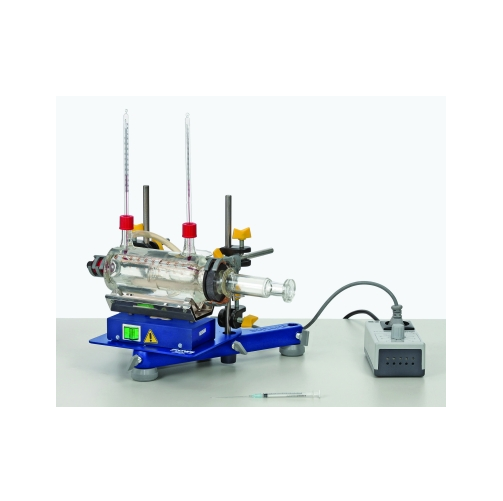
Equipment for hands-on chemistry work
This category serves laboratories and educational spaces where chemistry is taught through direct experimentation. Instead of treating all items as interchangeable lab supplies, it is more useful to view them as part of a practical measurement workflow: preparing solutions, dispensing liquids, monitoring reactions, and documenting results.
For example, burettes remain essential for controlled volumetric dispensing in titration exercises, while digital pH and conductivity sensors support faster reading, clearer trend visualization, and easier comparison between samples. In the same environment, a compact spectrophotometer can extend the scope of experiments into absorption and emission analysis, giving students or trainees exposure to a broader set of analytical methods.
From classic glassware to digital chemistry measurement
One of the strengths of this category is its combination of established laboratory tools and modern digital devices. Traditional items such as the PHYWE 47153-01 Burette With Straight Stopcock and PHYWE 47151-01 Burette With On The Side Glass Stopcock are well suited to titration tasks where controlled dosing and readable graduation are important. These tools continue to play a central role in chemistry education because they help users understand technique, precision, and procedural discipline.
At the same time, connected sensors simplify data capture and make experimental results easier to interpret. The PHYWE 12921-00 Cobra SMARTsense pH sensor is designed for convenient pH measurement and real-time display, while the PHYWE 12922-00 Cobra SMARTsense conductivity sensor helps measure conductivity or ion content in solution. For users building a broader practical lab setup, related categories such as tools and accessories can also support routine preparation and handling tasks.
Typical applications in teaching and training labs
Chemical equipment in this range is relevant for a variety of classroom and training scenarios. Titration is one of the clearest examples, where burettes, flasks, beakers, and pH measurement tools work together in a single exercise. Students can learn not only endpoint detection, but also how dispensing accuracy and measurement method affect the quality of the result.
Water and solution analysis is another practical use case. A pH sensor and a conductivity sensor can be used to compare samples, monitor changes during dilution or neutralization, and discuss ion concentration in a more visual way than manual methods allow. For more advanced demonstrations, the PHYWE 35630-00 Fibre-Optics Compact Spectrophotometer adds a route into spectral analysis across the visible range and adjacent regions, connecting chemistry with optics and instrumental methods.
Choosing the right equipment for your setup
Selection should be based on the type of experiment, the level of the users, and the desired balance between manual skill development and digital evaluation. If the main need is classical volumetric analysis, burettes with appropriate volume and graduation are a logical starting point. Smaller capacities and finer divisions can be useful where controlled dosing and more detailed reading are required, while larger options may suit general-purpose titration work.
If the goal is to increase engagement and reduce reading errors, digital sensors are often a strong addition. Wireless or USB-connected measurement devices can streamline lessons, especially when results need to be displayed, recorded, or compared across multiple groups. Complete sets such as the PHYWE 25303-88 Student Set Titration And Analytical Chemistry and the PHYWE 25303-88D digital version are particularly useful when a structured experiment environment is needed instead of sourcing each item separately.
Why integrated experiment sets matter
In many institutions, consistency across student groups is just as important as the equipment itself. A structured set helps standardize the tools available for each exercise, which supports repeatability, easier classroom management, and clearer instruction. This is especially relevant in analytical chemistry practice, where a missing or mismatched component can disrupt the flow of a lab session.
The student sets in this category illustrate that broader system view. Rather than focusing on a single device, they combine core items needed for titration and analytical chemistry work, and in the digital version, they also incorporate sensor-based measurement. For users comparing adjacent laboratory needs, the wider ecosystem may also include physical device solutions for cross-disciplinary training setups.
Points to consider before ordering
Before selecting equipment, it is worth checking how the products will actually be used day to day. Key questions include whether the lab emphasizes foundational manual technique, digital data capture, or a combination of both. It is also useful to consider whether equipment will be used for single-station demonstrations, distributed student workstations, or repeated multi-group classes.
Compatibility within the learning environment matters as well. Some users may prioritize simple standalone glassware, while others may benefit more from connected tools that work with software for recording and visualization. Where chemistry teaching overlaps with broader science instruction, users may also want to explore applied science equipment for complementary experimental contexts.
Supporting analytical thinking in the lab
Good chemistry equipment does more than enable a procedure; it helps users understand why the procedure works. A burette teaches controlled addition and volumetric reading. A pH or conductivity sensor helps translate chemical change into measurable data. A spectrophotometer introduces the idea that composition and behavior can be studied through light interaction as well as by visible reaction.
That combination makes this category suitable for educational laboratories that want to build both practical handling skills and measurement awareness. Whether the requirement is straightforward titration hardware or digitally supported chemistry experiments, the products here support a more structured and informative lab workflow.
When choosing from this category, the most effective approach is to match the equipment to the teaching objective, the experiment type, and the level of measurement detail required. With the right mix of glassware, sensors, and experiment sets, a chemistry workspace can become easier to manage, more consistent in use, and more valuable for real hands-on learning.
Types of Chemical equipment (74)
-
-
-
-
-
-
-
-
-
-
-
-
-
-
-
-
-
-
-
-
-
-
-
-