


Physical device
Hands-on physics teaching works best when concepts can be observed, measured, and repeated under controlled conditions. A well-structured range of physical devices helps schools, laboratories, and training centers move from theory to practical understanding, whether the topic is electricity, magnetism, optics, mechanics, or modern physics.
In this category, the focus is on equipment designed for demonstration, guided experiments, and foundational research training. The product mix supports both instructor-led setups and student-level experimentation, making it easier to build complete learning environments around measurable physical phenomena.
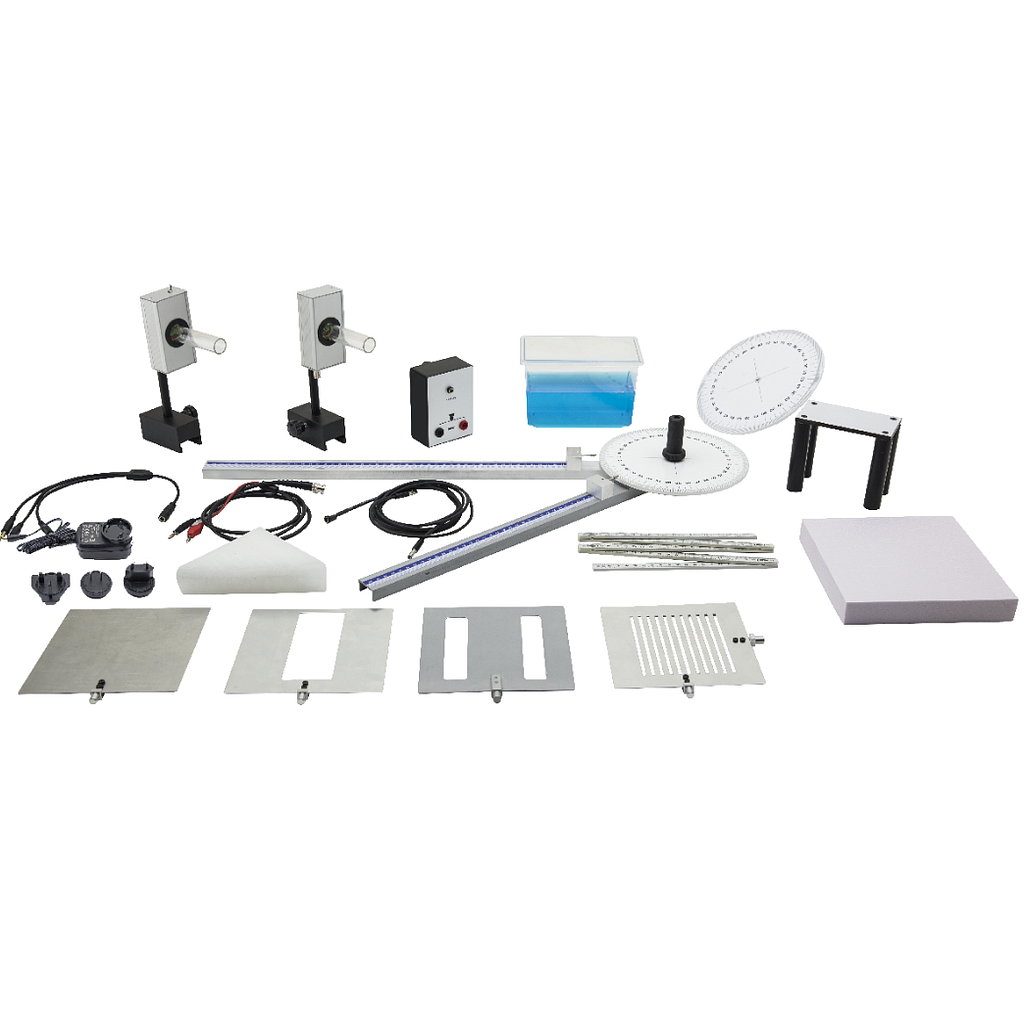
Built for practical physics education and experiment-based learning
Physics education equipment is not limited to a single type of instrument. In practice, it includes boards, sensors, amplifiers, probes, coils, and experiment modules that help users investigate electrical behavior, magnetic fields, radiation, photoelectric effects, and mechanical principles in a clear and repeatable way.
This category is especially relevant for laboratories that need equipment for introductory and intermediate experiments. Compared with adjacent fields such as chemical equipment or biological devices, physical devices are centered on measurable interactions such as force, charge, field strength, resistance, signal amplification, and wave behavior.
Typical equipment types found in this category
The range includes both complete experiment elements and supporting hardware. Some products are intended to serve as the core of an experiment, while others act as enabling components that improve signal quality, support data capture, or provide a safe and stable demonstration platform.
Examples from this category include the PHYWE P2410200 Wheatstone bridge for resistance measurement exercises, the PHYWE 11007-88 induction coils set for electromagnetic experiments, and the PHYWE 02150-00 Demo Physics Board with Stand for structured classroom demonstrations. For more advanced topics, products such as the PHYWE 06779-00 Photocell for h-determination and the PHYWE 13609-99 Geiger-Müller Counter support experiments in modern physics and radiation-related studies.
Applications across electricity, magnetism, optics, and modern physics
One of the strengths of this category is its broad experimental coverage. Electrical teaching setups can include resistance networks, bridge circuits, and voltage measurement exercises. Magnetic and electromagnetic demonstrations often rely on coils, Hall probes, and amplifiers to make field-related phenomena easier to observe and quantify.
Optical and quantum-related experiments also have a place here. The PHYWE 06779-00 Photocell for h-determination is a good example of equipment used to study the photoelectric effect and related constants, while Cobra SMARTsense radioactivity sensors and Geiger-Müller counters help introduce radiation measurement in a structured and classroom-friendly format. Where the application is more specialized, users may also explore related areas such as applied science equipment for broader experimental coverage.
How to choose the right physical device for your setup
Selection should start with the intended teaching objective or test method. If the goal is to explain basic electrical principles, a bridge circuit or standard demonstration board may be more useful than a high-sensitivity amplifier. If the task involves weak current measurement, electrostatics, or low-noise signal handling, specialized devices such as the PHYWE 13627-99 Ultra-Low-Noise Current Amplifier or the PHYWE 13621-00 Electrometer Amplifier become more relevant.
It is also important to consider the complete experiment chain: signal source, sensor or transducer, conditioning device, display or software environment, and mounting accessories. In many educational environments, the best results come from choosing equipment that is compatible with existing lab structures and easy for instructors to deploy repeatedly. Supporting items from tools and accessories may also be necessary to complete the workstation.
Why PHYWE is frequently specified for teaching laboratories
PHYWE is strongly associated with educational and experimental physics equipment, particularly in environments where repeatability, structured learning, and modular experiment design matter. In this category, the available products illustrate that breadth well, from basic resistance and induction experiments to radiation detection and photoeffect investigations.
The advantage of a consistent manufacturer ecosystem is not only brand familiarity. It also helps institutions standardize interfaces, teaching methods, and experiment preparation. That is especially useful when multiple lab stations must be configured around similar learning goals but at different levels of complexity.
Representative products and their role in the lab
Several products in this category are best understood as parts of an experimental ecosystem rather than isolated items. The PHYWE 13610-01 Hall Probe, for example, is used alongside appropriate magnetic field measurement systems, while the PHYWE 13625-93 Amplifier supports experiments that require signal enhancement for weak AC or DC voltages. These are enabling devices that make physical effects easier to detect, compare, and interpret.
Other items are more directly tied to instructional exercises. The Wheatstone bridge supports resistance determination and circuit analysis, induction coils support electromagnetic teaching, and Cobra SMARTsense radioactivity instruments simplify mobile or digital data collection. Even accessories such as the PHYWE 15510-01 Demo Advanced Mechanics 1 Necessary Accessories can be important when building a complete and usable teaching setup rather than purchasing only the primary experiment hardware.
Suitable for schools, universities, and training centers
This category is relevant for a wide range of B2B buyers, including schools, universities, technical institutes, and laboratory integrators. Some organizations need robust demonstration equipment for front-of-class teaching, while others require modular devices for student benches, repeated lab sessions, or practical examinations.
Because the category spans foundational and advanced topics, it can support both curriculum-based purchasing and incremental lab expansion. A buyer may start with general demonstration boards and core electrical experiment devices, then add radiation, optics, or field measurement tools as the program develops.
Choosing with long-term usability in mind
When comparing options, it helps to think beyond a single experiment. Equipment that supports multiple setups, integrates well into existing teaching workflows, and can be reused across semesters often delivers better value for educational institutions. That is especially true for measurement-oriented physics equipment, where compatibility and repeatability are just as important as the device itself.
For buyers building or upgrading a teaching laboratory, this category provides a practical starting point for selecting reliable physics experiment equipment across core subject areas. By matching the device type to the learning objective, measurement method, and lab environment, it becomes easier to assemble a setup that is both technically sound and effective for instruction.
Types of Physical device (245)
-
-
-
-
-
-
-
-
-
-
-
-
-
-
-
-
-
-
-
-
-
-
-
-