


Carbon Monoxide/ Dioxide Transmitters
Reliable gas monitoring is a core requirement in modern buildings, parking structures, loading areas, and ventilation systems. When a control system needs a stable analog signal for demand-based ventilation or alarm logic, Carbon Monoxide/ Dioxide Transmitters provide the link between gas sensing at the field level and building automation at the system level.
On this page, you can explore transmitters designed for continuous monitoring of CO, CO2, and related indoor air quality parameters. These devices are commonly selected for HVAC integration, enclosed-space safety, and ventilation control where dependable measurement, practical mounting options, and compatible output signals matter more than unnecessary complexity.
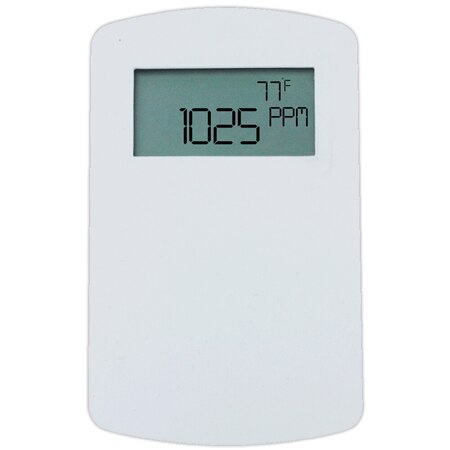
Where these transmitters are typically used
Gas transmitters in this category are often applied in spaces where air quality directly affects safety, comfort, or energy use. Carbon monoxide monitoring is especially relevant in parking garages, service bays, and loading docks, while carbon dioxide monitoring is widely used in offices, classrooms, meeting rooms, and other occupied indoor environments.
In many installations, the transmitter does more than detect gas concentration. It helps the control system adjust fan speed, trigger ventilation stages, or send a signal to a BMS or PLC. For broader airflow-related control strategies, users may also compare these devices with an air velocity transmitter when both gas concentration and duct performance need to be monitored together.
CO and CO2 monitoring serve different control goals
Although they are often grouped together, carbon monoxide and carbon dioxide transmitters are selected for different reasons. Carbon monoxide monitoring is generally tied to occupant safety and code-driven ventilation in enclosed or partially enclosed vehicle areas. Carbon dioxide monitoring, by contrast, is commonly used to support indoor air quality control and occupancy-based ventilation.
A practical example from the featured products is the Dwyer CDSN CO2 transmitter, which uses NDIR sensing and provides universal current or voltage outputs for building control integration. For garage and dock applications, the Dwyer GSTA series focuses on CO or NO2 monitoring with selectable outputs, making it easier to match existing BAS input requirements without redesigning the control panel.
Key selection points before choosing a transmitter
The right device usually depends on four basic questions: which gas needs to be measured, where the unit will be mounted, which signal the controller accepts, and whether local indication is needed. These factors affect both installation work and long-term maintenance.
Several models shown in this category support field-selectable analog outputs such as 4-20 mA and common voltage ranges. That flexibility can simplify replacement projects and retrofit work. Some versions are intended for wall mounting in occupied or open areas, while others are designed for duct mounting where the sensing point must follow airflow within an HVAC system.
- Gas type: CO2 for indoor air quality and demand-controlled ventilation, CO for enclosed-space safety and ventilation response.
- Mounting style: wall mount for room or garage zones, duct mount for air handling and ventilation paths.
- Signal compatibility: current or voltage output to match BAS, controller, or monitoring hardware.
- Local display and serviceability: LCD variants and field-replaceable sensors may help maintenance teams work faster.
Representative products in this category
The available range includes both room-style and duct-style transmitters for continuous gas measurement. For CO2 applications, the Dwyer CDSN model combines carbon dioxide sensing with temperature monitoring and supports multiple selectable output formats, which can be useful in commercial HVAC projects aiming for cleaner system integration.
For parking and dock ventilation, the Dwyer GSTA family includes wall-mount and duct-mount configurations, with versions offered with or without LCD display and with optional factory calibration certificate. Models such as GSTA-N-LCD-FC and GSTA-C-LCD-FC illustrate how the same product platform can be adapted to different gas ranges, installation preferences, and commissioning requirements. If your project standardizes on this supplier, you can also review the broader Dwyer product range for related sensing and control components.
Mounting, outputs, and integration considerations
In building automation projects, integration details can determine whether startup is straightforward or time-consuming. A transmitter with selectable current and voltage outputs gives more freedom when working with mixed control platforms or replacing an older unit whose original signal standard is no longer ideal.
Mounting style also matters. Wall-mounted devices are typically chosen for direct area monitoring in garages, docks, and occupied rooms, while duct-mounted versions are better suited to measuring gas concentration in moving air streams. When indoor air quality programs expand beyond gases alone, some facilities also evaluate particulate transmitters to build a more complete air monitoring strategy.
Sensor technology and maintenance expectations
Different sensing principles support different applications. In the products listed here, CO2 measurement is represented by NDIR technology, which is commonly chosen for stable carbon dioxide monitoring in HVAC and occupancy-driven ventilation systems. For CO and NO2 applications, electrochemical sensing is used in several featured models, including versions with field-replaceable sensors that can support practical maintenance planning.
From a lifecycle perspective, buyers should look beyond initial price and consider calibration approach, expected sensor service interval, enclosure suitability, and access for future replacement. A unit that is easy to wire, easy to configure, and easy to service can reduce maintenance effort over the life of the installation.
Choosing for retrofit vs new installations
In retrofit work, compatibility is usually the first priority. Existing controllers may already be set up for a specific analog input range, and conduit location or mounting space may limit which housing style can be used. In that situation, transmitters with switch-selectable outputs and multiple form factors are often easier to deploy.
For new installations, the selection process can be more performance-driven. Engineers may prioritize sensing method, display preference, maintenance strategy, and system standardization across multiple sites. Buyers comparing brands may also want to review OMEGA instrumentation solutions if the project calls for a wider measurement portfolio across environmental and process variables.
Practical buying guidance
Before ordering, it helps to confirm whether the application is primarily about safety ventilation, indoor air quality, or both. That single decision will usually narrow the choice between CO-focused and CO2-focused transmitters. Next, verify mounting location, output type, display preference, and whether a calibration certificate is needed for project documentation.
This category is built for users who need dependable gas measurement devices that fit real control systems, not just isolated sensors. By matching the transmitter to the application environment and control architecture, you can simplify commissioning, improve monitoring reliability, and support a more effective ventilation strategy over time.
-
-
-
-
-
-
-
-
-
-
-
-
-
-
-
-
-
-
-
-
-
-
-
-