


Ecology & Environment Equipment
Field observation, environmental monitoring, and classroom experimentation often depend on one thing: reliable data that is easy to collect and interpret. Ecology & Environment Equipment supports that need with instruments used to measure water quality, light, humidity, weather conditions, gas concentration, and other variables that help explain how natural systems behave.
This category is relevant for schools, universities, research labs, and training environments that need practical tools for environmental science, biology, and interdisciplinary experiments. It brings together devices suited to hands-on learning as well as more advanced analytical work, making it easier to build measurement setups for both basic demonstrations and more structured investigations.
What this category is used for
Environmental study rarely focuses on a single parameter. In real applications, users may need to compare temperature, humidity, illumination, chemical concentration, and atmospheric conditions to understand a biological process or a local ecosystem. That is why this category includes tools for both physical environmental measurement and chemical analysis.
Typical use cases include monitoring classroom greenhouse conditions, studying photosynthesis, checking water turbidity, measuring nutrient ions in solution, and recording weather data during outdoor experiments. For broader life science setups, these instruments can also complement related areas such as botany equipment when plant growth and environmental response need to be evaluated together.
Main instrument groups in ecology and environmental work
A practical ecology lab usually combines several types of devices rather than relying on one instrument alone. Environmental sensing tools are useful for tracking ambient conditions, while chemical measurement devices help quantify what is happening in water, soil extracts, or closed experimental vessels.
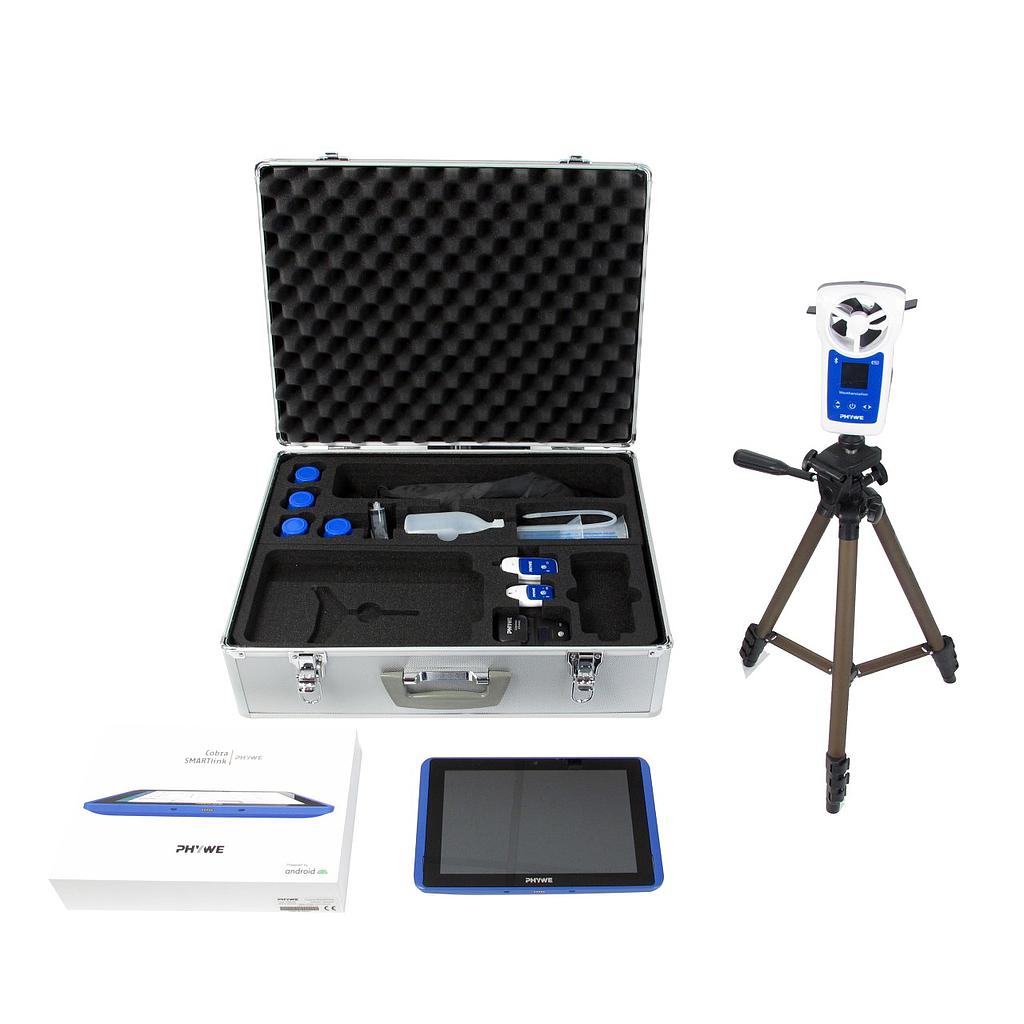
Examples in this category include the PHYWE Cobra SMARTsense series for light, relative humidity, weatherstation, colorimeter, CO2, and ion measurement tasks. For analytical chemistry workflows that require more controlled titration and endpoint evaluation, solutions from HANNA add another level of laboratory capability, especially where pH, mV, or ion-selective measurement is part of the test method.
Examples of equipment available
For ambient and outdoor studies, the PHYWE 12946-00 Cobra SMARTsense Weatherstation is a good example of a multi-parameter device that can record wind-related, atmospheric, and light-related values in one setup. In teaching and research contexts, this helps users correlate changing weather conditions with environmental observations instead of treating each variable separately.
For focused measurements, dedicated sensors such as the PHYWE 12906-01 light sensor and PHYWE 12931-01 relative humidity sensor are useful where a single parameter must be monitored with minimal setup. The PHYWE 12924-01 colorimeter extends the category into water and sample analysis by supporting transmittance, absorbance, and turbidity measurement, which are common in environmental and educational chemistry workflows.
Where dissolved ions are important, selected Cobra SMARTsense sensors such as the nitrate, ammonium, potassium, calcium, and chloride ion versions can support nutrient and solution analysis. These are especially relevant in plant studies, water testing exercises, and experiments related to fertilization, aquatic systems, or environmental chemistry.
Why connectivity and ease of use matter
In education and training, instrument usability is often just as important as measurement capability. Many users need equipment that can be deployed quickly in a lab, classroom, or outdoor setting without complex interfaces or specialized data loggers. Devices in the PHYWE Cobra SMARTsense family address this by supporting Bluetooth or USB connectivity with digital end devices, which helps simplify data capture and visualization.
This kind of workflow is valuable for demonstrations, student experiments, and introductory research projects because it reduces setup time and allows faster interpretation of trends. Instead of spending most of the session configuring hardware, users can focus on the environmental question itself, whether that means observing photosynthesis, comparing microclimates, or following changes in sample quality over time.
How to choose the right ecology and environment equipment
The best choice depends on the parameter being measured, the expected concentration or operating range, and the level of control required in the experiment. For general environmental observation, a weatherstation or single-parameter sensor may be enough. For sample-based analysis, users may need a colorimeter, a gas sensor, or an ion-selective measurement device depending on the target variable.
It is also important to consider the measurement environment. Portable and app-connected sensors are often more convenient for fieldwork or student use, while benchtop systems are better suited to controlled laboratory procedures. If the application involves water quality or solution chemistry, attention should be paid to probe type, calibration workflow, sample handling, and whether the method requires direct sensing or titration.
- For outdoor and ambient studies: prioritize portability, multi-parameter coverage, and fast data logging.
- For water and solution analysis: focus on the relevant chemical parameter, expected range, and calibration method.
- For teaching environments: ease of use, software compatibility, and quick setup are often key selection factors.
- For advanced laboratory tasks: consider automated systems when repeatability and more structured methods are required.
From environmental sensing to analytical chemistry
Some ecology applications stay at the level of observation, while others move into deeper analysis. For instance, a weather or light measurement may explain changing growth conditions, but water chemistry often requires more precise analytical tools. That is where benchtop instrumentation such as the HANNA HI932C2-02 automatic potentiometric titration system becomes relevant for specialized workflows involving pH, mV, or ISE-based determinations.
This broader measurement ecosystem is useful in institutions that combine biology, chemistry, and environmental science. A teaching lab may begin with portable sensors for introductory experiments, then expand toward structured analysis as curriculum complexity increases. Users exploring related laboratory areas may also find useful overlap with cell biology equipment or human physiology equipment where environmental conditions influence biological response.
Typical applications in education and research
This category supports a wide range of teaching and experimental scenarios. In ecology classes, users may measure light intensity, humidity, and weather trends to study habitat conditions. In environmental chemistry, they may analyze turbidity, ion content, or gas concentration in order to understand pollution, nutrient balance, or biological activity.
Several listed products are particularly well suited to applied learning. The PHYWE 12932-20 Cobra SMARTsense CO2 Basics Set Photosynthesis can support photosynthesis experiments in closed vessels, while ion sensors such as nitrate or ammonium models are relevant for discussions around fertilization, water quality, and nutrient cycling. These use cases make the category practical not only for instrument purchasing but also for designing complete experimental workflows.
Choosing with a complete workflow in mind
When selecting ecology and environment instruments, it helps to think beyond a single device. A useful setup often combines sensing, sample preparation, data recording, and interpretation. In many cases, the most effective approach is to start with the variable that matters most, then add complementary tools as the measurement task becomes more detailed.
Whether the requirement is a portable weatherstation, a classroom-ready digital sensor, or a more advanced analytical system, this category provides a practical starting point for environmental measurement. By matching the instrument to the application, users can build clearer experiments, collect more meaningful data, and support better decisions in teaching, research, and environmental observation.
-
-
-
-
-
-
-
-
-
-
-
-
-
-
-
-
-
-
-
-
-
-
-
-