


Ultrasonic Pulse Velocity
When concrete quality needs to be assessed without damaging the structure, Ultrasonic Pulse Velocity testing is one of the most practical non-destructive methods available. It helps engineers, laboratories, inspectors, and contractors evaluate internal uniformity, identify potential voids or cracks, and support condition assessment for concrete members, piles, slabs, and other structural elements.
On this category page, you can explore a focused range of ultrasonic concrete testing instruments used for transit-time measurement, pulse transmission, pulse echo inspection, and related non-destructive evaluation tasks. The selection is relevant for both field inspection and laboratory workflows where repeatability, signal clarity, and efficient data handling matter.
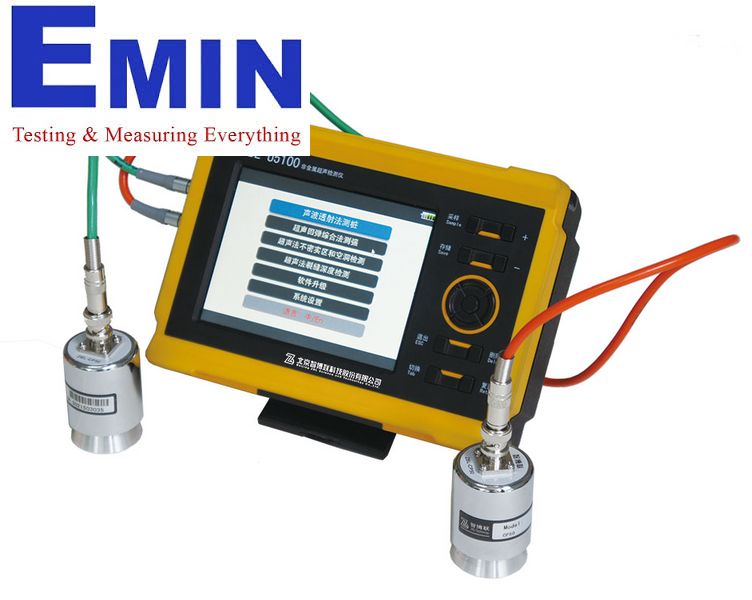
Why ultrasonic pulse velocity testing is widely used
UPV testing is commonly applied to estimate concrete uniformity by measuring the travel time of an ultrasonic pulse through a material. Changes in transit time can indicate differences in density, internal flaws, crack paths, or other discontinuities that may not be visible from the surface.
In practical inspection work, this method is valuable because it is fast, repeatable, and suitable for in-situ as well as controlled testing environments. It is often used alongside other concrete evaluation methods such as a concrete test hammer to build a more complete picture of structural condition.
Typical applications in concrete inspection
Ultrasonic instruments in this category are used for more than a simple velocity reading. Depending on the device and test setup, they can support crack depth estimation, void detection, pile assessment, delamination checks, and the investigation of non-homogeneous zones within concrete.
For example, the PCE PCE-UCD 100 Ultrasonic Tester is positioned for tasks such as detecting concrete piles, estimating concrete strength, and evaluating void or crack dimensions. PROCEQ solutions such as the PD8050 Pundit Ultrasonic and PI8000 Pundit Pile Integrity and Impact Echo are relevant when imaging, pulse echo workflows, or pile integrity assessment are part of the inspection scope.
Where reinforcement location is important before placing transducers or interpreting anomalies, users may also review cover meter and rebar detector tools to complement the ultrasonic testing process.
Common instrument types in this category
This category includes several equipment styles to match different testing objectives. Conventional transit-time instruments measure how long the pulse takes to pass between transducers, which is a standard approach for concrete quality comparison and basic structural investigation.
Examples include the Matest C369N Ultrasonic Pulse Velocity, RTUL 4607 Ultrasonic Concrete Tester, and Proceq Pundit Lab / Pundit Lab Plus models. These are suitable for users who need established pulse velocity workflows, straightforward operation, and portable instruments for regular inspection tasks.
There are also more advanced systems designed for broader non-destructive testing applications. The PROCEQ PD8050 Pundit Ultrasonic uses multi-channel ultrasonic pulse echo technology, while the Samyon SYC61 and SYC62 Nonmetal Ultrasonic Detector models fit applications where nonmetal structural evaluation and high time accuracy are important.
How to choose the right ultrasonic tester
Selecting the right instrument depends first on the inspection goal. If the main requirement is standard transit time measurement for concrete quality comparison, a classic UPV device may be sufficient. If the work involves complex structures, deeper imaging, or pile investigations, a pulse echo or multi-channel platform can be more appropriate.
It is also useful to compare several practical factors:
- Measurement range and time resolution for the level of detail required
- Testing mode, such as through transmission or pulse echo
- Display and data handling convenience for field or lab use
- Portability, battery operation, and durability for site conditions
- Probe configuration and suitability for the structure under test
For users comparing brands, pages from PROCEQ and PCE can be helpful starting points when evaluating different inspection workflows and device ecosystems.
Examples of products available
Several representative products show the range of solutions available in this category. The Matest C369N is a dedicated ultrasonic pulse velocity instrument designed for measuring the time required for the pulse to pass through the tested material, with onboard data acquisition and PC connection support.
The RTUL 4607 Ultrasonic Concrete Tester is a compact through-transmission unit aimed at routine concrete testing. For users requiring broader field capability, the Proceq Pundit Lab and Pundit Lab Plus offer established UPV functionality for applications such as void finding, crack depth measurement, and inspection of concrete or wood.
At the more advanced end, the PROCEQ PD8050 supports line, stripe, and grid scanning for imaging-focused applications, while the PI8000 is intended for pile integrity and impact echo work. The PCE PCE-UCD 100 adds a larger display and a wider set of concrete-focused measurement functions, making it relevant where documentation and visual interpretation are part of the workflow.
Related tests often used alongside UPV
Ultrasonic pulse velocity is rarely the only method used in structural assessment. In many real inspection scenarios, it works best as part of a broader testing plan that may include rebound testing, cover measurement, permeability-related checks, or corrosion evaluation depending on the structure and failure mechanism under investigation.
If the project also involves water penetration or concrete resistance to fluid ingress, the permeability test category may be relevant. Where durability of reinforced concrete is the focus, rebar corrosion detection tools can extend the inspection scope beyond internal pulse transmission measurements.
Who this category is suitable for
This product group is relevant for civil engineering laboratories, quality control teams, infrastructure inspectors, precast manufacturers, contractors, consultants, and educational institutions. It supports both acceptance testing and diagnostic work on existing structures where non-destructive evaluation is preferred.
It can also be useful in investigations of piles, slabs, beams, tunnels, and other concrete elements where access conditions vary. Some users need a straightforward portable unit for routine field checks, while others require a more advanced platform for mapping, imaging, or post-processing of inspection results.
Choosing with confidence
The right ultrasonic concrete tester depends on whether your priority is routine UPV measurement, deeper flaw detection, pile integrity analysis, or a broader non-destructive testing workflow. Looking at the test method, structure type, data requirements, and inspection environment will usually narrow the options quickly.
This category brings together portable and advanced solutions from recognized manufacturers such as Matest, PCE, PROCEQ, RTUL, and Samyon, making it easier to compare instruments for your specific application. If you are building a full concrete inspection setup, ultrasonic pulse velocity equipment can serve as a strong foundation for consistent and informative non-destructive assessment.
-
-
-
-
-
-
-
-
-
-
-
-
-
-
-
-
-
-
-
-
-
-
-
-