


Surface Resistivity Tester
When evaluating reinforced concrete, durability often matters just as much as compressive strength. Electrical resistivity testing is widely used to assess how easily ions and moisture can move through concrete, helping engineers, inspectors, and quality teams understand corrosion risk, curing consistency, and permeability-related behavior without destructive sampling. That makes the Surface Resistivity Tester category especially relevant for field assessment, maintenance planning, and quality control in civil and infrastructure projects.
Why surface resistivity testing is used in concrete assessment
Surface resistivity is a practical non-destructive method for examining the electrical properties of concrete. In real project conditions, it is commonly used to estimate the likelihood of reinforcement corrosion, indicate relative corrosion rate trends, and support evaluation of chloride permeability. Because concrete durability is closely linked to moisture movement and pore structure, resistivity measurements can also help identify wet and dry zones, variations in water-cement behavior, and areas more exposed to chloride ingress.
For contractors, consultants, laboratories, and asset owners, this type of instrument supports faster decision-making on site. It can be useful during acceptance testing, rehabilitation surveys, condition mapping, and long-term durability monitoring, especially when a quick field method is needed before deeper investigation.
What to expect from this product category
In this category, users typically look for portable instruments designed for direct resistivity measurement on concrete surfaces or related bulk testing workflows. A handheld format is valuable in site environments because measurements often need to be taken across multiple zones of slabs, columns, tunnels, bridges, or precast elements. Good field usability usually means stable measurement resolution, onboard memory, battery-powered operation, and accessories that support repeatable contact on the test surface.
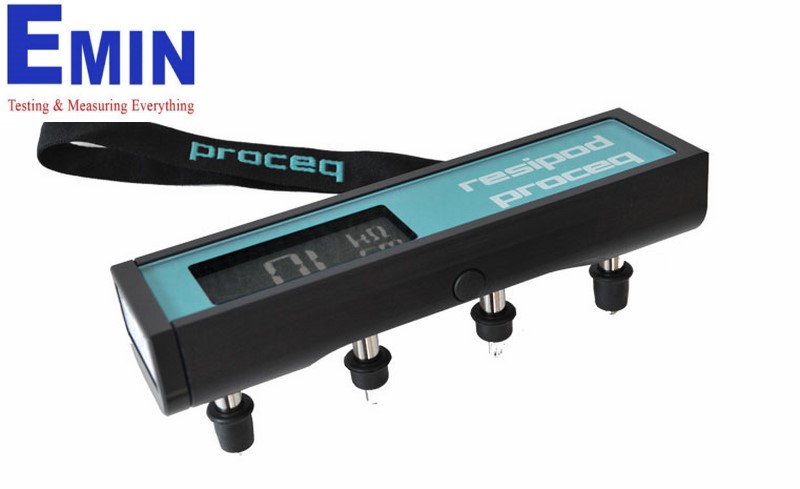
Several products in this range come from PROCEQ, a manufacturer well known in concrete inspection and non-destructive testing. Representative models in this category include the PROCEQ Resipod Resistivity Meter, PROCEQ ResipodGeometric Resistivity Meter, and PROCEQ ResipodBulkResistivity Resistivity Meter. These instruments are commonly selected when users need a compact tool for durability-related concrete evaluation rather than only strength-focused testing.
Typical applications in the field
A surface resistivity tester is often used where corrosion durability and transport properties need to be understood quickly. Common use cases include bridge deck surveys, parking structures, marine-exposed concrete, repair validation, precast quality checks, and inspection of structures exposed to de-icing salts or aggressive environments. In these situations, resistivity data can help teams prioritize suspect zones for further testing or repair.
Beyond corrosion-related analysis, resistivity testing can also support curing assessment and comparison of concrete uniformity across a structure. It may be used to identify areas with differing moisture conditions or to compare sections with potentially different permeability characteristics. In some workflows, it complements visual inspection and cover investigation performed with a cover meter or rebar detector.
How these instruments fit into a broader concrete testing workflow
Resistivity measurement is most valuable when interpreted as part of a broader condition assessment process. It does not replace every other concrete test, but it adds a useful layer of information about transport behavior and corrosion-related exposure. For example, engineers may combine resistivity mapping with rebound testing, reinforcement location, and corrosion-focused inspection to build a more complete picture of structural condition.
Depending on the project, users may also compare findings with results from permeability testing or use it alongside rebar corrosion detection methods. This combined approach is often more useful than relying on a single indicator, especially when evaluating existing structures with variable age, moisture exposure, and chloride contamination.
Representative models in this category
The PROCEQ Resipod Resistivity Meter is a well-known option for concrete resistivity measurement in field applications. It is suited to users who need a portable instrument with practical storage capacity, rechargeable operation, and accessories for routine testing across multiple inspection points. For day-to-day durability assessment, this type of tool supports efficient data collection without adding excessive complexity.
The PROCEQ ResipodGeometric Resistivity Meter and PROCEQ ResipodBulkResistivity Resistivity Meter illustrate how the category can address different testing preferences or sample evaluation methods. While the exact selection depends on the intended workflow, these product types are typically considered when users want to compare surface-oriented measurements with bulk resistivity approaches or align the method with laboratory and field requirements.
What to consider when choosing a surface resistivity tester
The right instrument depends on where and how it will be used. In field inspection work, buyers often prioritize portability, stable measurement performance, battery autonomy, memory for recorded values, and accessories that help maintain consistent contact with the surface. Ease of handling also matters when the operator needs to test many points across a large concrete area.
It is also important to match the tester to the actual engineering question. Some users focus on corrosion likelihood, while others need support for chloride permeability correlation, curing evaluation, or identification of moisture-related variations within the structure. If the project requires a broader survey toolkit, it may also make sense to review related methods such as the concrete test hammer for quick comparative surface assessment in different parts of the structure.
Who typically uses this category
These instruments are commonly selected by civil engineering consultants, inspection companies, concrete laboratories, contractors, infrastructure maintenance teams, and owners responsible for long-life assets. They are especially relevant in projects where durability, corrosion exposure, and repair prioritization are more important than a simple pass/fail strength check.
Because the method is non-destructive and relatively fast, it is useful in both new construction and existing structure assessment. It can support acceptance review of concrete quality, comparison of repaired versus unrepaired areas, and mapping of zones that may require further investigation.
Choosing with application in mind
For many buyers, the best choice is not simply the one with the most features, but the one that fits the testing objective and operating environment. A compact handheld unit may be ideal for routine site surveys, while a model aligned with bulk resistivity evaluation may be more suitable when sample-based comparison is part of the process. The value of the measurement comes from using the right method consistently and interpreting results within the actual condition of the structure.
This category is built for users who need practical tools for concrete durability assessment, corrosion-related screening, and permeability-oriented evaluation. If you are comparing instruments for field use, start with the testing method you need, the surface conditions you expect, and whether the resistivity data will be used on its own or alongside other concrete inspection techniques.
-
-
-
-
-
-
-
-
-
-
-
-
-
-
-
-
-
-
-
-
-
-
-
-