


Magnetic and V block, clamp
Reliable holding and positioning are essential whenever round workpieces need to be checked, marked, machined, or compared with tight tolerances. In workshop inspection, toolroom work, and general mechanical measurement, the right fixture helps keep shafts, pipes, and cylindrical parts stable so results are repeatable and handling is safer. This is where Magnetic and V block, clamp products fit into the measuring setup.
Within this category, you will find practical solutions for supporting cylindrical components, securing them during inspection, and maintaining alignment during measuring or light workshop operations. The range typically supports applications such as comparative gauging, dimensional checks, layout work, and bench holding where a standard flat support is not enough.
Why V-blocks and clamps matter in measurement work
A V-block is designed to cradle round or hexagonal parts in a stable position. Combined with a clamp, it helps prevent rolling or shifting while the operator measures diameter, runout, concentricity, or position. This simple holding method is widely used because it improves consistency without requiring a complex fixture.
In many inspection tasks, the fixture is just as important as the measuring instrument itself. Even a high-quality gauge can produce unreliable results if the part is not properly supported. For this reason, V-blocks are often used together with dial indicators when checking roundness, alignment, or variation on turned components.
Magnetic V-blocks and standard V-blocks
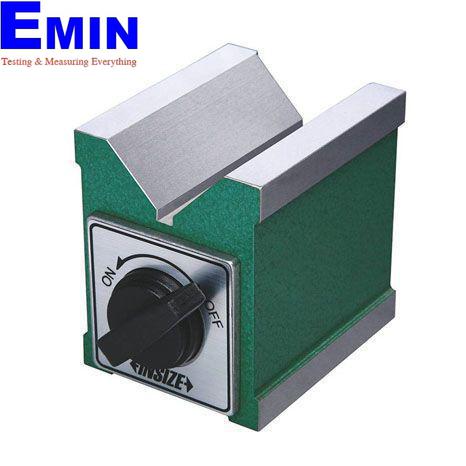
The category includes both magnetic V-blocks and conventional vee blocks with clamps. Each style serves a slightly different purpose. Magnetic versions are useful when additional holding force is needed, especially for ferrous workpieces that must remain stable during inspection or setup.
A representative example is the KANETEC KMV-125D magnetic V-block set. With a stated holding force and capacity suited to larger cylindrical parts, this type of solution is practical in machine shops and inspection stations where speed and repeatable positioning are important. Standard paired vee blocks such as the MOORE & WRIGHT 212, 213, 214, 215, 216, and MW211 series are more traditional inspection accessories, commonly selected by capacity and required accuracy.
Where magnetic holding is unnecessary, a mechanical clamp remains a straightforward and dependable option. Products such as MOORE & WRIGHT vee blocks supplied in pairs are suitable for supporting a broad range of workpiece sizes while maintaining predictable geometry for checking dimensions with tools like callipers or micrometer-style instruments.
Typical applications in workshops and inspection rooms
These tools are commonly used for supporting shafts, pins, tubes, and other cylindrical parts during manual measurement. They are also helpful in marking-out work, light assembly support, and comparative checks where the part must be kept from rotating. In quality control environments, a pair of vee blocks can simplify repeat measurements across multiple similar components.
For example, a compact setup may involve placing the part on vee blocks, securing it with a clamp, and then checking runout with an indicator or confirming external dimensions with a handheld instrument. In more practical bench tasks, a holding tool such as the TOPTUL DJAC0104 cast steel bench vise or TOPTUL DJAD0104 forged steel bench vise may be preferred when stronger general-purpose clamping is needed rather than precision support.
When thickness or wall section is part of the inspection process, these fixtures can also complement other tools in the measuring workflow, including a thickness meter, by helping the operator orient the workpiece consistently before readings are taken.
How to choose the right item for your job
The first factor is workpiece geometry. Round bars, shafts, and pipes require a support that matches the part diameter range, while the clamp must apply enough holding force without distorting the component. For many buyers, capacity is more important than simply choosing the largest block available, because oversizing can reduce handling convenience and fixture efficiency.
The second factor is the required level of measurement confidence. Where inspection accuracy matters, look at the stated accuracy and build quality of the vee blocks. In the MOORE & WRIGHT range, several models differ by capacity and accuracy, making it easier to match the fixture to smaller or larger cylindrical parts without overcomplicating the setup.
Material and operating environment also matter. Magnetic blocks are most useful on ferrous parts and in tasks where quick positioning is needed. A bench vise is more appropriate for firm holding during workshop operations, while a classic paired vee block and clamp is generally better for inspection support than for heavy-duty clamping.
Representative brands and product options in this category
This category includes products from established manufacturers used in industrial and workshop environments. MOORE & WRIGHT is particularly relevant here for traditional vee blocks, clamps, and spare clamp-and-screw components such as 23001 and 23101, which help maintain existing setups. These replacement parts are useful where fixture bodies remain serviceable and only the clamping hardware needs renewal.
KANETEC adds magnetic holding solutions for users who need additional stability on suitable workpiece materials. TOPTUL appears in the category through bench vise options that broaden the holding ecosystem for workshop use, especially where general clamping is required alongside measuring and setup tasks.
Although this page focuses on one fixture group, buyers often compare options across broader measuring brands such as MITUTOYO, Niigata Seiki, TECLOCK, and KERN depending on how the holding setup will be used in a larger inspection process.
Practical selection tips for B2B purchasing
For maintenance teams, QA departments, and machine shops, it helps to standardize fixtures by common part size. This reduces setup time and makes inspection routines easier to repeat across shifts or workstations. If your team regularly checks small shafts, there is little benefit in choosing a large-capacity block when a more compact model offers better handling and sufficient accuracy.
It is also worth considering whether you need single-purpose support, paired precision blocks, magnetic holding, or replacement clamp hardware. A spare clamp and screw can be the most cost-effective solution when the main vee block remains in good condition. On the other hand, a full magnetic set may be more suitable if you are trying to improve speed and positioning reliability for repeated checks on ferrous cylindrical parts.
Finally, think about the surrounding measuring process. If the work involves outside dimensions, comparative reading, and bench inspection, the combination of stable V-block support and appropriate measuring tools will usually deliver more repeatable results than trying to hold the part by hand or with a non-matching fixture.
Supporting a more consistent inspection workflow
Good measurement practice depends on more than the instrument alone. Stable support, correct orientation, and controlled clamping all contribute to reliable readings. That is why magnetic V-blocks, vee blocks with clamps, and related holding accessories remain useful across machining, maintenance, and inspection environments.
If you are selecting fixtures for cylindrical parts, this category provides a practical starting point for matching capacity, holding method, and application type. Whether you need a precision pair of vee blocks, a magnetic holding option, a bench vise for general support, or replacement clamping hardware, choosing the right setup can make daily measurement work more efficient and more consistent.
-
-
-
-
-
-
-
-
-
-
-
-
-
-
-
-
-
-
-
-
-
-
-
-