


TMAH concentration meter
Accurate control of TMAH concentration is important wherever alkaline process liquids must be checked consistently, whether for incoming inspection, process monitoring, or routine lab verification. On this page, you can explore TMAH concentration meter solutions designed for practical measurement work, with options suited to different concentration ranges and measurement methods.
Because tetramethylammonium hydroxide is handled in tightly controlled environments, users typically look for instruments that are easy to calibrate, stable in day-to-day use, and suitable for small sample volumes. This category focuses on that need, helping buyers compare measurement approaches and identify the right tool for their workflow.
Where TMAH concentration meters fit in liquid testing
In liquid analysis, concentration measurement is not only about getting a number on the display. It is also about repeatability, sample handling, and choosing an instrument that matches the expected concentration band of the liquid being tested. For TMAH applications, that usually means selecting between different sensing principles depending on whether the task calls for low-range or high-range measurement.
This category sits within broader water and liquid testing workflows, where users may also work with supporting tools such as ion measurement electrodes or consumables like other reagents. In practice, TMAH measurement often forms one part of a wider quality control routine rather than a completely isolated task.
Two common measurement approaches in this category
A practical difference in this lineup is the measurement method. One option uses an electrode-based approach for sampled liquid, which is suitable when users need direct concentration checking in a lower percentage range. This type of instrument is often selected for routine checks where portability and straightforward operation are priorities.
The other option uses spectrophotometry with water sampling measurement. This approach is relevant when the application requires measurement in a higher concentration range expressed in g/L. Choosing between these methods depends less on preference and more on the concentration range, sampling conditions, and how the measurement result will be used in the process.
Representative KASAHARA instruments in this category
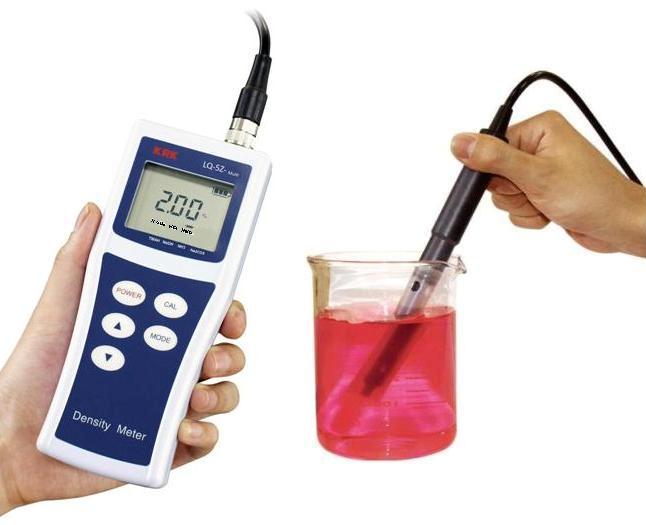
Among the featured products, the KASAHARA lineup provides a clear example of how TMAH measurement needs can differ. The KASAHARA LQ-5Z-TMAH TMAH Meter is designed for electrode-based water sampling measurement over a 0.05 to 5.00% range, making it suitable for applications where lower concentration monitoring and automatic temperature compensation are useful in daily operation.
For higher-range measurement, the KASAHARA IR-V1-TMAH TMAH concentration Meter supports spectrophotometric measurement from 0 to 250 g/L. It also includes data memory for a limited number of measurement records, which can be helpful for spot checks, comparison work, or simple record review during field or bench use. These examples show why concentration range should be one of the first selection criteria.
How to choose the right TMAH concentration meter
The first point to confirm is the expected concentration range. If your samples are evaluated in percentage terms at relatively low levels, an electrode-based meter may be the better fit. If your application requires checking higher concentrations in g/L, a spectrophotometric model may be more appropriate. Selecting the wrong range can reduce usability even if the instrument itself is technically capable.
Next, review sample temperature conditions, calibration workflow, and handling requirements. Some users prioritize zero calibration simplicity, while others need zero-span calibration flexibility. Sample volume can also matter in environments where only a small amount of liquid is available for testing or where minimizing waste is important.
Power supply and portability are also worth checking for field or mobile inspection work. Battery-powered instruments with auto power-off functions can support routine use without adding much setup complexity. If your measurement setup includes multiple analytical steps, related tools such as test paper may still serve as a quick screening aid before confirmatory instrument measurement.
What buyers often compare before purchase
In B2B purchasing, decision-makers usually compare more than headline range values. They also look at calibration style, sample temperature tolerance, portability, memory functions, and whether the instrument is intended for water sampling measurement rather than continuous inline monitoring. These points affect both usability and training requirements for operators.
Another common comparison is accessory structure. Electrode-type instruments rely on the condition and handling of the measuring electrode, while spectrophotometric models depend on the optical measurement process and the sampling procedure. Understanding that difference helps buyers match the meter to their internal SOPs and maintenance practices.
Suitable applications and workflow considerations
TMAH concentration meters are typically used where liquid composition must be checked reliably as part of process control or inspection work. In these environments, portability, quick startup, and consistent sample preparation are often more valuable than unnecessary complexity. That is why handheld or compact meters remain practical choices for many industrial and laboratory users.
When building a broader testing workflow, users may combine concentration measurement with category-adjacent tools depending on the sample and purpose. For example, some teams may maintain separate accessories for chemical handling, basic screening, or complementary liquid analysis. The main goal is to keep the measurement process repeatable and aligned with the concentration range the instrument was designed to handle.
Choosing with confidence
If you are comparing options in this category, start with the fundamentals: concentration range, measurement principle, calibration needs, and sampling conditions. From there, it becomes much easier to narrow the selection between electrode-based and spectrophotometric instruments without overcomplicating the buying process.
A well-matched TMAH concentration meter supports more reliable liquid testing and smoother day-to-day operation. By focusing on the real measurement task rather than only headline specifications, buyers can identify the instrument that best fits their process, operator workflow, and quality control requirements.
-
-
-
-
-
-
-
-
-
-
-
-
-
-
-
-
-
-
-
-
-
-
-
-