


Laundry & Dish washing testing/ analysing
In commercial laundry, hospitality, food service, and institutional cleaning, chemistry control has a direct impact on washing performance, fabric care, hygiene, and operating cost. Reliable test tools help teams verify whether detergent concentration, bleach strength, hardness, pH, and residual chemicals stay within the expected range instead of relying only on visual inspection or operator experience.
Laundry & Dish washing testing/ analysing covers the practical side of checking wash-process quality in liquid-based cleaning environments. This category is relevant for routine monitoring, troubleshooting inconsistent results, and supporting repeatable cleaning procedures where water quality and chemical dosing matter.
Why process testing matters in washing applications
Cleaning results depend on more than detergent alone. Water hardness, pH balance, oxidizing agents, and residual chlorine can all influence stain removal, rinse quality, fabric feel, corrosion risk, and overall chemical efficiency. In dish washing systems, the same factors also affect surface cleanliness, spotting, and sanitizing consistency.
Testing brings these variables into a measurable workflow. Instead of adjusting chemistry by guesswork, maintenance teams, laboratories, and quality control staff can compare results over time and make more informed decisions about dosing, water treatment, or corrective action.
What you can evaluate in this category
This category is centered on routine analytical needs related to laundry and dish washing operations. Typical checks include hardness testing, detergent verification, bleach control, residual chlorine checks, iron assessment, and pH monitoring. These are common control points when wash quality must remain stable across repeated cycles.
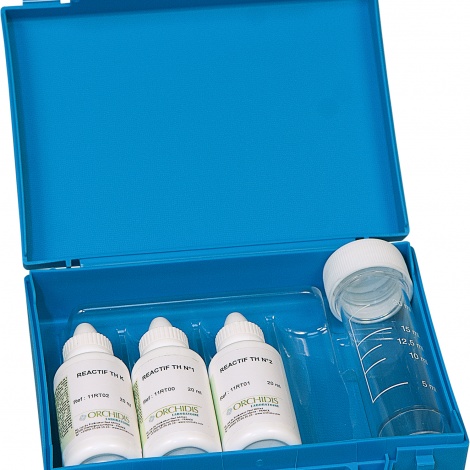
For users who need broad, application-focused kits, the Aqualabo range provides useful examples. The Aqualabo 1MB007 Laundry Case is positioned as a practical set for multiple routine checks in laundry environments, making it relevant where several water and chemistry parameters need to be reviewed together rather than one by one.
Examples of products used for routine control
Some products in this category are designed as dedicated standards or test kits for a specific parameter, while others support a wider analytical workflow. The HANNA HI97708-11 Nitrite High Range CAL Check™ Standards, for example, illustrates the role of calibration and verification materials in maintaining confidence in measurement results. Although it is focused on nitrite, it reflects an important principle in process testing: analytical readings are only useful when instruments and methods are checked properly.
For bleach-related verification, the Aqualabo 1CC016 Bleach control kit chlorometric (47/50°) highlights the need for chemical strength checks in applications where oxidizing agents are part of the wash process. In many facilities, keeping bleach concentration within the right window helps balance cleaning performance with material compatibility and operator safety.
How to choose the right testing approach
The right solution depends on how the washing process is managed. If operators need fast field checks during daily operation, compact kits and simple color or titration-based methods are often easier to integrate into routine work. If the goal is better traceability or tighter process validation, standard solutions and more formal measurement procedures may be more appropriate.
It is also useful to think about the number of parameters that must be monitored. A multi-parameter case can simplify recurring checks in laundries, while single-parameter products may be the better fit for targeted verification, such as bleach control or confirmation of a specific water quality issue. Where consumables are part of the workflow, related items such as test paper or other reagents may complement the main testing setup.
Understanding the broader testing ecosystem
Not every item associated with washing analysis is a direct detergent or rinse test. Some products support preparation, handling, or adjacent laboratory work. The Benchmark SmartWasher™ 96 SmartWashe (230V), for instance, is a laboratory plate washer rather than a laundry machine accessory. Its presence helps show that this category can include equipment involved in liquid handling and analytical workflows around testing tasks.
Likewise, the OXOID ST8090 Antibiotic Disc Dispenser 8 place belongs more naturally to a microbiology handling context than to wash chemistry control itself. Still, it indicates that users browsing this area may also work in lab-based quality environments where liquid testing, sample handling, and verification activities overlap. For brand-specific exploration, you can also review the wider HANNA product range for measurement and checking tools used in liquid analysis.
Typical users and application scenarios
These products are relevant in on-premise laundries, textile care operations, central sterile support environments, institutional kitchens, hospitality facilities, and industrial wash processes where chemical performance must be monitored consistently. They are also useful for service providers who maintain dosing systems or investigate recurring complaints such as poor wash quality, excessive chemical use, spotting, or variable rinse outcomes.
In practice, testing may be carried out as part of daily startup checks, periodic quality audits, troubleshooting after process drift, or validation of chemical changes. Where water composition plays a major role, related tools such as a domestic ion measurement electrode can also be relevant for more specific ionic analysis.
What to consider before ordering
Before selecting a product, it helps to define the parameter being checked, the expected measurement range, and whether the result is needed for quick operational guidance or for more formal documentation. Users should also consider sample type, test frequency, training level of the operator, and whether replacement reagents or standards will be required over time.
Method suitability is just as important as the product itself. A simple kit can be highly effective for routine plant use, while a calibration standard may be essential where instrument verification is part of the procedure. Matching the testing method to the real workflow usually leads to better consistency than choosing solely on price or convenience.
Supporting stable washing quality with measurable data
Consistent laundry and dish washing results come from controlling the variables that affect chemistry and water interaction. This category brings together tools that help users check those variables in a practical, repeatable way, from bleach and detergent-related control to broader liquid analysis support.
If you are comparing options, focus on the parameters you need to monitor most often, the level of accuracy your process requires, and how easily the test can be integrated into daily operation. A well-matched testing workflow can reduce uncertainty, improve process control, and make wash-quality decisions more evidence-based.
-
-
-
-
-
-
-
-
-
-
-
-
-
-
-
-
-
-
-
-
-
-
-
-