


Iodine Concentration Meter
Reliable iodine monitoring matters wherever water chemistry must be controlled with consistency, whether in process water, treatment routines, laboratory checks, or field verification. A dedicated Iodine Concentration Meter helps users measure low-level iodine content more clearly than visual comparison methods, making routine testing faster and easier to standardize.
On this category page, you can explore compact instruments designed for iodine analysis in liquid samples. These meters are especially useful when operators need repeatable readings, straightforward handling, and practical performance for day-to-day water testing workflows.
Why iodine concentration measurement is important
Iodine is used in various water-related and sanitation applications, so measuring its concentration is essential for maintaining process control and verifying chemical treatment levels. If iodine is too low, the intended treatment effect may not be achieved; if it is too high, it can affect product quality, compliance targets, or downstream process conditions.
For that reason, many users prefer instruments that provide a direct numerical result rather than depending only on subjective color interpretation. In technical environments, a meter supports more consistent decision-making across operators, sites, and testing intervals.
How an iodine concentration meter typically works
Most portable iodine meters in this category are used as compact photometric instruments. In general, the sample reacts with a reagent to produce a color change, and the instrument measures the light response of that treated sample to calculate the iodine level.
This approach is well suited to routine water testing because it combines practical portability with a structured analytical method. Compared with simple strip-based checks, a meter can offer better readability and improved repeatability when users need documentation-friendly values. For related consumables used in analytical workflows, you may also review other reagents.
Typical features users look for
When selecting an instrument in this category, buyers usually focus on several practical points: measurement range, resolution, ease of calibration or setup, operating temperature conditions, and how suitable the device is for field use. Compact dimensions, battery operation, and automatic shut-off can also be important for technicians who carry the meter between sampling locations.
Another key factor is the underlying test method. A portable photometer designed for iodine testing generally depends on a defined reagent-based procedure, so users should consider not only the instrument itself but also the availability of the correct test chemicals and accessories needed for routine measurement.
- Measurement clarity for low-level iodine readings
- Portable format for field and spot testing
- Simple operating steps for repeatable daily use
- Compatibility with reagent-based testing workflows
- Practical battery-powered operation
Example product in this category
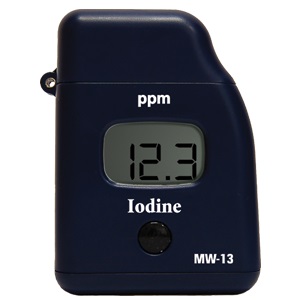
A representative model is the MARTINI MW13 Iodine Handy Photometer, a compact meter intended for iodine measurement in liquid samples. Based on the available product data, it is built around a photometric method and offers a portable form factor suitable for routine testing tasks.
This model is associated with the DPD method adaptation for water and wastewater examination, using a reagent reaction that produces a pink tint in the sample for analysis. Its measurement span and handheld design make it relevant for users who need a simple instrument for regular verification rather than a large benchtop setup.
Manufacturer context and product ecosystem
This category includes solutions from MILWAUKEE, a manufacturer recognized in portable measurement equipment for water and liquid analysis. For buyers working across multiple test parameters, choosing an established manufacturer can simplify sourcing, user familiarity, and continuity in everyday operation.
In many real testing environments, iodine measurement is only one part of a broader quality-control routine. Teams may combine photometric testing with other liquid analysis tools depending on the application, sample type, and required reporting format.
How to choose the right meter for your application
The most suitable instrument depends on how and where measurements are taken. If testing is done on-site, portability and quick operation may be more important than advanced bench features. If the workflow is repetitive, users often prioritize stable readings, simple handling, and easy reagent preparation.
It is also useful to consider whether your process relies on a broader ion or chemical analysis workflow. In applications where ion-selective methods are part of the overall setup, related tools such as a domestic ion measurement electrode may provide additional context for broader water testing requirements.
Where fast screening is enough, simpler methods can still play a role alongside a dedicated meter. For example, test paper may be used for quick checks, while a photometric meter is better suited to obtaining a more defined numeric reading.
Applications in routine water and liquid testing
Iodine meters can be relevant in laboratories, treatment verification tasks, sanitation control points, and general industrial liquid testing where iodine presence must be tracked consistently. The exact workflow varies by industry, but the core need remains the same: obtaining a dependable measurement from a defined sample preparation method.
Because many users operate under time pressure, compact meters are often favored for their balance of speed and practicality. They fit well into maintenance rounds, incoming quality checks, and process validation routines where frequent measurements are required without excessive setup.
Supporting more reliable testing decisions
An iodine concentration meter is a practical choice when visual checks are no longer sufficient and a clearer numeric result is needed. By combining a reagent-based method with portable photometric measurement, these instruments help technical users improve repeatability in everyday liquid testing.
If you are comparing options in this category, focus on the intended testing range, workflow simplicity, reagent requirements, and the type of operating environment involved. That makes it easier to select a meter that fits your process rather than choosing only by model name or basic specifications.
-
-
-
-
-
-
-
-
-
-
-
-
-
-
-
-
-
-
-
-
-
-
-
-