


Smart Home Sensor
Reliable sensing is what turns a connected home from a simple collection of devices into a system that can actually respond to daily activity, safety events, and changing room conditions. Whether the goal is intrusion awareness, fire warning, or automated lighting logic, choosing the right Smart Home Sensor setup helps create a smarter and more practical environment for residential projects, apartments, villas, and small commercial spaces.
On this category page, you can explore sensor devices designed to work within a broader smart home ecosystem. The focus is not only on detection, but also on how sensors communicate with controllers, trigger automation scenarios, and support more stable operation across the installation.
Why sensors matter in smart home automation
In a modern automation system, sensors act as the input layer. They detect what is happening in the space and send that information to the control platform, allowing other devices to react automatically. This is especially useful for everyday functions such as turning lights on when movement is detected, notifying users when a door opens, or raising an alarm when smoke is present.
Compared with manual control alone, a sensor-based system improves both convenience and awareness. It also supports more efficient operation because actions are triggered only when needed, which can help reduce unnecessary energy use and simplify routine tasks.
Typical sensor types in this category
This category includes several practical sensor types used in smart home projects. A door sensor is commonly installed on entry doors, windows, cabinets, or gates to detect open and close status. A PIR motion sensor is useful for occupancy-based automation in hallways, living rooms, stairs, and utility areas.
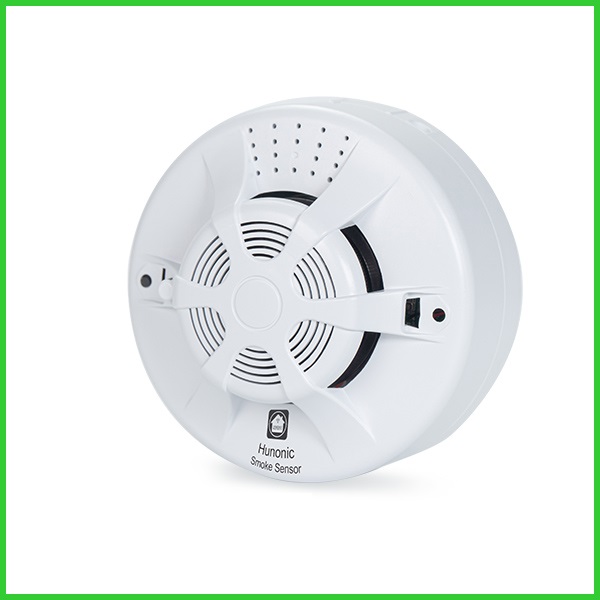
For safety applications, a smoke sensor plays an important role in early warning. In the current range, examples such as the HUNONIC HNSSSMKR Smoke Sensor, HUNONIC HNSSDOOR Door Sensor, and HUNONIC HNSSPIR Motion Sensor show how different sensing functions can be combined within one connected system rather than deployed as isolated devices.
If you are building a broader sensing and detection layer, you can also review related options in the smart home sensor range alongside switching and automation components that expand system logic.
Integration with controllers and the wider ecosystem
Sensors deliver the most value when they are part of a coordinated architecture. In this ecosystem, devices can work with central control hardware such as the HUNONIC HNHSV Home Server Central Controller, which is intended to connect devices and support a smart network. This type of setup is useful when multiple rooms or zones need centralized monitoring and automation logic.
For access-related control, the HUNONIC HNGATE Gate controller can complement sensor-based operation by linking entry events with automated actions. In practice, this means door status, motion detection, and gate control can all contribute to a more connected workflow instead of functioning as separate standalone products.
Where switching automation is also required, it may be helpful to combine sensors with a smart switch solution so lighting or other loads can respond automatically to presence, timing, or status changes.
Wireless communication and installation considerations
Several featured devices in this category are built around Bluetooth Mesh communication. In smart home applications, this approach is attractive because it supports networked device communication without requiring every endpoint to be wired back to a central control panel. It can be especially practical in retrofit projects where minimizing construction work is important.
Power method is also an important selection point. Some devices use batteries for flexible placement, while controller-level equipment may use a fixed low-voltage supply. Battery-powered sensors are often easier to install on doors, walls, or ceilings, but users should still consider maintenance planning, especially in projects with many sensing points.
Placement quality matters just as much as communication method. Motion sensors should be positioned based on detection angle and expected walking paths, while smoke sensors should be located where they can provide timely warning without being affected by unsuitable environmental conditions.
How to choose the right sensor for your application
The first step is to define the function clearly. If the objective is security awareness at openings, a door sensor is usually more appropriate than a motion detector. If the objective is automatic lighting or occupancy-based control, a PIR sensor is generally the more suitable option. For life-safety monitoring, smoke detection should be considered as a separate and essential layer.
The second step is to check system compatibility. Users should confirm how the sensor connects, whether it requires a server or central controller, and how it fits into the intended automation logic. This is particularly important when the project includes multiple device types such as sockets, gate control, or curtains.
It is also worth considering the expansion path. A small installation may start with a few detection points, but many projects later add more devices for convenience and control. For example, a sensor-driven setup can be extended with a smart curtain motor or connected power devices such as a Hunonic socket to create broader automation scenarios.
Featured HUNONIC options in this category
HUNONIC is the main featured manufacturer in this category, with products that cover sensing, control, and smart home connectivity. Rather than focusing on a single device, the brand’s value in this context comes from offering components that can work together across detection and automation tasks.
Representative products include the HUNONIC HNSSSMKR Smoke Sensor for safety monitoring, the HUNONIC HNSSDOOR Door Sensor for access status detection, and the HUNONIC HNSSPIR Motion Sensor for movement-based triggers. For larger logic and integration needs, the HUNONIC HNHSV Home Server Central Controller supports the network layer, while the HUNONIC HNGATE Gate controller extends the system toward entry management.
Common use cases for smart home sensors
In residential settings, sensors are often used to automate entry lighting, monitor perimeter openings, and improve response to unusual events. A door sensor can notify users when a door is opened, while a motion sensor can activate lights in corridors or stair areas only when presence is detected. A smoke sensor adds another layer of protection by supporting earlier awareness of potential fire-related incidents.
These devices can also be useful in small offices, rental properties, and showroom spaces where remote awareness and simple automation improve day-to-day management. The exact design will depend on the number of rooms, the expected user behavior, and how tightly the sensors need to interact with controllers and other smart devices.
Choosing a scalable sensor platform
A good sensor category is not just about individual products; it is about building a system that remains practical as requirements change. When comparing options, look at communication method, installation flexibility, controller compatibility, and the types of events each sensor is designed to detect. This makes it easier to create a setup that works well today and can still expand later.
For projects that need dependable detection as part of a connected automation environment, this Smart Home Sensor category provides a useful starting point. By selecting the right mix of motion, door, and smoke sensing devices, users can build a more responsive, safer, and more manageable smart home system.
-
-
-
-
-
-
-
-
-
-
-
-
-
-
-
-
-
-
-
-
-
-
-
-