


Cable S7-200/300/400/HMI/Logo
Reliable communication is a basic requirement in PLC programming, HMI setup, and routine maintenance. When engineers need to transfer projects, connect a PC to a controller, or link operator panels to automation hardware, the cable itself becomes a critical part of the workflow. This category brings together Cable S7-200/300/400/HMI/Logo solutions used in Siemens automation environments, with options suited to programming, data transmission, and device-to-device connection tasks.
For integrators, maintenance teams, and industrial buyers, choosing the right cable is not only about connector type. It also affects commissioning speed, communication stability, and compatibility with the target PLC or interface. In practical terms, a suitable cable helps avoid wasted troubleshooting time when working with S7 systems, HMI devices, and LOGO! controllers.
Where these cables are used in automation systems
In day-to-day industrial automation, communication cables are commonly used for program upload and download, diagnostics, parameter setting, and operator interface connection. They may be required during initial panel build, machine retrofit, maintenance shutdowns, or on-site troubleshooting. A technician connecting a laptop to an S7-200 PLC has a different need from an engineer linking a LOGO! controller or an HMI terminal.
This is why the category includes several connection formats rather than one generic cable type. Some products are intended for PC-to-PLC programming, others support HMI communication, and some are designed for Ethernet or MPI-based connectivity. If your application also requires matching network accessories, it can be helpful to review related bus connector options within the same Siemens ecosystem.
Typical cable types found in this category
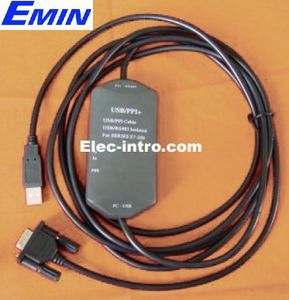
The range covers familiar connection needs across Siemens platforms. Examples include the SIEMENS 6ES7972-0CB20-0XA0 cable for PC-to-PLC S7 USB communication, the SIEMENS 6ES7901-3DB30-0XA0 USB/PPI cable for S7-200, and the SIEMENS S7-200/300/HMI, 6ES7901-0BF00-0AA0 MPI cable. These products illustrate the different communication methods used across legacy and established Siemens automation systems.
For compact control applications, LOGO! programming cables are also relevant. Models such as SIEMENS 6ED1057-1AA00-0BA0 Logo! Pc Cable and Siemens 6ED1057-1AA01-0BA0 LOGO! USB PC CABLE are intended to support project transfer between a PC and LOGO! devices. In addition, this category includes specialized items such as the TD 200C to S7-200 connecting cable and Ethernet options like SIEMENS 6XV1850-2GE50, which may be useful depending on the communication architecture in use.
How to choose the right cable for your PLC or HMI
The first step is to identify the exact device family and communication interface. S7-200, S7-300, S7-400, HMI panels, and LOGO! controllers may use different ports and protocols, even when the cables seem similar at a glance. USB, PPI, MPI, Ethernet, and dedicated programming interfaces each serve a different purpose, so cable selection should start with the hardware port on both ends of the connection.
Next, consider the actual maintenance or engineering task. A cable used mainly for program transfer from a PC does not always serve the same role as one used for panel communication or network connection. For projects involving Siemens operator panels, buyers may also want to explore related HMI solutions for S7-200/300/400 to confirm device compatibility across the full system.
Examples of applications across S7, HMI, and LOGO!
In a small machine or standalone control cabinet, a LOGO! programming cable may be enough for application updates and simple commissioning work. In these cases, a PC cable such as 6ED1057-1AA00-0BA0 or the USB version 6ED1057-1AA01-0BA0 can support routine logic transfer between engineering software and the controller.
For more traditional PLC installations, cables such as 6ES7901-3DB30-0XA0 for S7-200 or 6ES7972-0CB20-0XA0 for USB-based PC-to-PLC communication help technicians connect directly for diagnostics and programming. In HMI-related setups, dedicated connection cables like TD 200C to S7-200, 6ES7901-3EB10-0XA0, support interaction between the display device and the controller. Where network-based communication is part of the system design, Ethernet cable options and complementary Siemens HMI equipment may also be relevant during project planning.
Why cable compatibility matters in industrial environments
In industrial automation, connection issues are often discovered at the worst possible time: during startup, maintenance windows, or urgent fault recovery. Using the wrong cable can lead to failed communication, wasted engineering hours, and uncertainty about whether the issue lies in the controller, software, or physical interface. A category focused on Siemens-compatible PLC and HMI cables helps buyers narrow down options more efficiently.
Compatibility also affects long-term serviceability. Many plants continue to operate mixed generations of hardware, especially across S7-200, S7-300, S7-400, and HMI installations. Having access to the right programming and interface cables supports ongoing maintenance for installed systems without forcing unnecessary hardware changes. For buyers who want to stay within a recognized supplier ecosystem, the broader SIEMENS product range can provide additional context.
Products in this category as part of a wider connection ecosystem
Not every item here is a main communication lead in the same sense. Some products play a supporting role in the connection chain, such as adapters, connector formats, or control line assemblies. For example, SIEMENS Jack Jack Male+Female and SIEMENS 3RK1902-4PB15-3AA0 CABLE CONTROL LINE reflect the fact that industrial connectivity often depends on multiple small components working together, not only one programming cable.
This matters for B2B purchasing because system reliability usually depends on complete connection planning. A cable may need to match the PLC port, the engineering station, the panel interface, and the physical installation environment. Looking at the category as an application-focused set of connection tools is often more useful than treating each cable as an isolated spare part.
Support practical purchasing for maintenance, retrofit, and integration
For maintenance teams, the priority is often replacing an existing cable with the correct equivalent so that service work can continue without delay. For integrators and panel builders, the focus may be on selecting the right cable during project design to support commissioning and future access. In both cases, clear identification of the target device family is more important than choosing based on appearance alone.
This category is especially relevant for users working with established Siemens automation platforms, including S7 PLCs, HMIs, and LOGO! devices. Reviewing the intended communication path, connector type, and application purpose will usually lead to a more reliable purchasing decision than simply searching for a generic PLC cable.
Whether the requirement is PC-to-PLC programming, HMI connection, LOGO! project transfer, or a supporting communication accessory, this category helps organize the cable options used across common Siemens control platforms. A careful match between device, interface, and task will make commissioning and maintenance more straightforward while reducing avoidable connection issues in the field.
-
-
-
-
-
-
-
-
-
-
-
-
-
-
-
-
-
-
-
-
-
-
-
-