


Mica and PTFE Capacitors
Stable capacitance, low loss, and predictable behavior at higher frequencies are often the reasons engineers narrow their search to Mica and PTFE Capacitors. In RF circuits, precision timing networks, filtering stages, and high-voltage designs, these capacitor types are valued when long-term electrical consistency matters more than simply choosing the most common general-purpose part.
This category is intended for buyers who need dependable capacitor options for demanding electronic assemblies. The available range is especially relevant for designs that require tight tolerance, through-hole mounting, and performance that remains consistent across changing operating conditions.
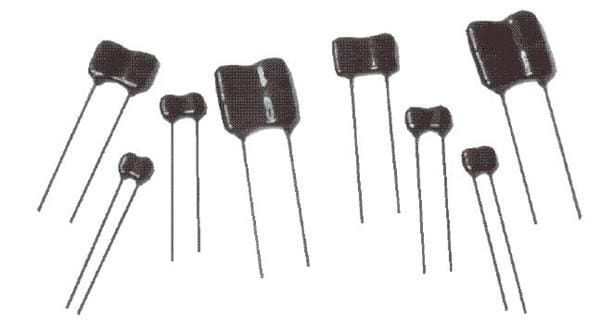
Why mica and PTFE capacitor technologies are selected
In many industrial and electronic applications, capacitor choice is not only about capacitance value. Designers also look at dielectric behavior, tolerance stability, voltage capability, and how the part performs in signal-sensitive circuits. That is where mica dielectric solutions are often preferred, particularly in precision analog, RF, and high-frequency environments.
Within this category, the product mix prominently includes mica capacitors from Cornell Dubilier (CDE). These parts are commonly considered when engineers want a combination of compact format, through-hole installation, and controlled electrical characteristics for more specialized circuit requirements.
Typical applications for mica capacitors
Mica capacitors are frequently used in resonant circuits, oscillators, coupling and tuning networks, and other sections where capacitance drift can affect system behavior. Their suitability becomes more apparent in designs where signal integrity or frequency accuracy is important, including RF equipment, laboratory instruments, communications hardware, and certain industrial control electronics.
They can also be appropriate for high-voltage points in a circuit, depending on the required value and layout constraints. In this category, buyers will find parts spanning very small capacitance values for fine tuning as well as higher pF and low nF ranges that fit filtering, compensation, and precision network applications.
What to review when selecting a part
The first practical step is to match the capacitance range to the circuit function. Very low values such as 6pF, 9pF, or 20pF may be more relevant for RF tuning and compensation, while values like 510pF, 910pF, 1500pF, 2400pF, 3000pF, or 4300pF may better suit coupling, filtering, bypassing, or timing-related tasks depending on the design.
Voltage rating is equally important. The listed products include options at 100V, 300V, 500V, and 1000V DC, so engineers should confirm normal operating voltage, transient conditions, and appropriate design margin. Tolerance also matters when the capacitor directly affects frequency response or calibration behavior, especially in circuits that cannot tolerate significant variation.
Mechanical factors should not be overlooked. Many parts in this category use through-hole radial construction, which can be advantageous for robust board assembly and certain legacy or serviceable designs. If your project requires comparison with more compact multilayer options, it may also be useful to review ceramic capacitors for applications where dielectric behavior and package priorities differ.
Representative products in this category
Several examples help illustrate the range available. The Cornell Dubilier (CDE) CD4 series includes compact mica capacitors such as CD4CD060JO3F at 6pF and CD4CD090JO3F at 9pF, both suitable for circuits where small capacitance values are required. For slightly higher values, CD4FC621GO3F offers 620pF at 300V, while CD4FA911GO3 and CD4FA112GO3 support applications needing 910pF and 0.0011uF respectively.
For designs that need higher voltage or broader general-purpose mica coverage, products such as CDV19FF242FO3F and CDV19FF432FO3F extend into 1000V-rated configurations. Other examples like CD18FD152JO3, CMR06F511JODM, CMR06F302GODR, CMR04E200JODR, and CDV19CF100JO3 show the variety of capacitance values and package sizes that can support different board-level constraints.
How this category fits within a broader capacitor selection
Not every circuit needs mica or PTFE technology. In power smoothing, bulk energy storage, or DC link support, designers often move toward alternatives with much larger capacitance values. For those use cases, browsing aluminum electrolytic capacitors or aluminum polymer capacitors may provide a more suitable starting point.
By contrast, mica and PTFE-related selections are typically chosen for electrical precision rather than bulk capacitance. This makes the category especially relevant when the performance target involves low loss, stable dielectric behavior, and reliable operation in circuits where small shifts in capacitance can have a noticeable effect.
Practical buying considerations for B2B sourcing
For production, maintenance, and engineering procurement teams, selecting the right capacitor also means checking consistency across tolerance, mounting style, operating temperature range, and voltage class. Small differences between part numbers can change whether a component is appropriate for prototyping, qualification, or full production release.
It is also useful to consider whether the capacitor is being purchased for new design work, repair of existing assemblies, or long-term component standardization. In many industrial environments, through-hole mica capacitors remain important because they align with established designs, field-repair practices, and applications where electrical stability is prioritized over minimum package size.
Choosing the right mica and PTFE capacitor for your application
A good selection process starts with the circuit objective: tuning, compensation, filtering, timing, or high-voltage support. From there, narrow the options by capacitance value, tolerance, voltage rating, temperature capability, and mounting format. Reviewing representative parts from Cornell Dubilier (CDE) can help identify whether a compact CD4 series device or a larger higher-voltage option is a better fit.
This category is most useful when your design calls for capacitor performance that is consistent and application-specific rather than purely general-purpose. If you are comparing technologies across an electronic assembly, use this section as a focused source for precision-oriented capacitor options that support stable and reliable circuit behavior.
-
-
-
-
-
-
-
-
-
-
-
-
-
-
-
-
-
-
-
-
-
-
-
-