


Oscillator
Stable signal generation sits behind timing, synchronization, audio testing, and many measurement tasks across electronics and telecommunications. When engineers look for an Oscillator, they are usually balancing frequency range, waveform quality, package format, and how easily the device can be integrated into a wider test or control system.
In this category, the focus is on practical oscillator solutions used in technical and industrial environments. Rather than treating every design the same, it helps to evaluate how the oscillator will be used: as a clock source, a tunable signal source, or part of a dedicated test setup where distortion, output level, and frequency adjustment matter.
Where oscillators fit in electronic and telecom systems
An oscillator generates a periodic electrical signal from a DC supply, commonly in sine-wave or square-wave form depending on the circuit structure and application. That signal can be used to establish timing in digital electronics, provide a reference in communication circuits, or create test tones for verification, calibration, and troubleshooting.
Within broader telecommunication components, oscillators often work alongside devices that route, isolate, or distribute signals. In more complex RF and measurement setups, engineers may also consider related components such as isolators or a power divider when building stable signal paths.
Key oscillator characteristics that matter in selection
Frequency range is usually the first filter, but it should not be the only one. A suitable part also needs the right output level, acceptable distortion, and a package style that fits the target equipment or board design. For lab and production use, these factors can affect both signal integrity and ease of implementation.
Another important point is the method of frequency setting. Several products in this category are resistor-tunable oscillators, where external resistors determine operating frequency. This approach can simplify integration in custom circuits and embedded designs that need flexible signal generation without adding a large amount of supporting circuitry.
Typical product examples in this category
NF is one of the most relevant manufacturers in this selection, with multiple resistor-tunable models covering low to mid frequency requirements. For example, the NF CG-402R1 and NF CG-302R1 address the 20 Hz to 20 kHz range, which is often associated with audio-band testing, low-frequency signal work, and general-purpose waveform generation in electronics development.
For higher ranges, models such as the NF CG-402R2, CG-302R2, and CG-102R2 extend operation from 1 kHz to 100 kHz, while the NF CG-202R3 reaches 100 kHz to 1 MHz. Across these examples, buyers can compare practical differences such as package type, output flexibility, and distortion performance depending on the precision level required.
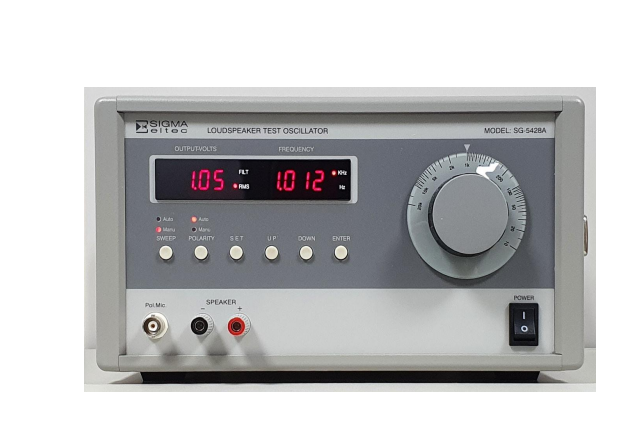
This category also includes more application-specific equipment. The SIGMA SG-5428A loudspeaker test oscillator is a good example of a dedicated signal source for audio and electroacoustic evaluation, covering 10 Hz to 30 kHz. That makes it relevant for users who need a focused test instrument rather than a compact oscillator module for integration into another system.
Understanding waveform quality and distortion
For many engineers, not all oscillators are interchangeable even when the nominal frequency range looks similar. In audio testing, sensor excitation, and precision analog work, waveform purity can be just as important as the frequency itself. Lower distortion generally helps produce cleaner measurements and reduces uncertainty introduced by the signal source.
Some NF models in this category specify very low distortion figures, making them suitable where clean sine-wave generation is important. In practical terms, this can support development tasks such as amplifier checks, filter evaluation, or general analog circuit testing. By contrast, in basic timing applications, the primary concern may be stable oscillation and easy frequency adjustment rather than extremely low harmonic content.
Choosing by application instead of only by frequency
A useful way to narrow down oscillator options is to start from the application environment. If the oscillator will be embedded in a compact circuit, package style and external component requirements may carry more weight. If it will be used in a test bench or quality control context, output level control, signal flatness, and distortion may become the deciding factors.
For telecom and signal-routing systems, the oscillator may also be part of a larger chain that includes switching and interface hardware. In those cases, it can be helpful to review related categories such as telecommunication switches or adapters to ensure compatibility across the full setup.
Package style and integration considerations
The products listed here include single-in-line and dual-in-line package formats, which can influence board layout, socketing, and maintenance. For OEM design, prototype development, or service replacement, mechanical compatibility is often just as important as the electrical specification.
Output voltage options are also worth reviewing carefully. Several models indicate a standard output around 2.5 Vrms with broader possible output ranges depending on configuration. That makes them relevant for engineers who need a source that can be adapted to the sensitivity of the next stage, whether the load is part of a test fixture, an analog front end, or a specialized measurement path.
How this category supports technical sourcing
For B2B buyers, oscillator selection is rarely about a single spec line. Procurement teams, maintenance engineers, and design groups often need a component or instrument that matches the actual use case, fits existing hardware constraints, and offers predictable performance across repeated use. A structured category page helps shorten that evaluation process by bringing together products from recognized manufacturers and presenting them in a more comparable context.
Beyond standalone signal generation, some applications may intersect with broader measurement platforms from brands such as NI, especially where telecom, PXI-based systems, or mixed electrical and optical test environments are involved. That makes this category relevant not only for discrete oscillator sourcing, but also for engineers building complete lab or production test workflows.
Final considerations before selecting an oscillator
The right choice depends on how the signal will be used in the real system: as a timing reference, a tunable source, or a dedicated test instrument. Looking at frequency range alone can be misleading if distortion, output level, package style, or adjustment method are critical to performance.
By comparing actual operating needs with the oscillator formats and representative models available here, buyers can make a more reliable shortlist for design, maintenance, or test applications. If you are selecting for telecom, electronics development, or audio-related measurement work, this category provides a practical starting point for finding an oscillator that fits the job without overcomplicating the design.
-
-
-
-
-
-
-
-
-
-
-
-
-
-
-
-
-
-
-
-
-
-
-
-