


Mixer
Frequency conversion sits at the heart of many RF and microwave test setups. When engineers need to translate a signal from one band to another for analysis, transmission, or subsystem integration, a Mixer becomes one of the key components in the signal chain.
This category brings together mixers used across telecommunication and electronic measurement environments, from lower-frequency lab work up to microwave and millimeter-wave ranges. Whether the priority is broad RF coverage, integrated local oscillator control, or a simple passive-style interface with standard connectors, selecting the right device starts with understanding the application, frequency plan, and required signal performance.
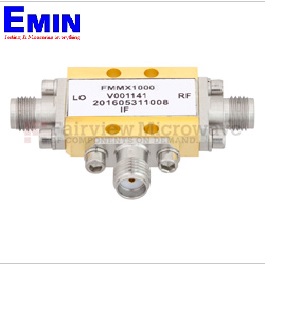
Where mixers are used in RF and telecom systems
In practical terms, a mixer is used to shift an incoming RF signal to a different intermediate frequency or to upconvert an IF/baseband signal toward a higher band. This makes mixers relevant in receivers, transmit paths, spectrum monitoring, signal intelligence workflows, converter modules, and many benchtop measurement architectures.
They are often deployed alongside other passive and RF routing components. For example, depending on the system layout, engineers may also need power dividers for signal splitting, or isolators to help manage reflections and improve stability in sensitive RF paths.
Key selection criteria for a mixer
The most important starting point is the relationship between RF, LO, and IF frequency ranges. A mixer must support the intended input band and the desired output or intermediate frequency without forcing an impractical frequency plan. In broadband environments, this often means checking not just the headline RF range, but also how much IF bandwidth is available for the downstream instrument or subsystem.
Beyond frequency coverage, engineers typically evaluate conversion loss, isolation between ports, compression behavior, and linearity. Specifications such as typical IP3, P1dB, LO leakage, and return loss influence how well the mixer will handle stronger signals, how much unwanted feedthrough appears at adjacent ports, and how easily it integrates into a 50-ohm measurement chain.
Connector style and mechanical interface also matter. In some setups, SMA is entirely adequate, while higher-frequency designs may require interfaces such as 2.92 mm to maintain usable performance deeper into the microwave range. If the surrounding architecture includes interface changes, matching the mixer with appropriate RF adapters can simplify installation without redesigning the full signal path.
Integrated LO mixers versus conventional broadband mixer options
One practical way to divide this category is between mixers with an integrated local oscillator and more conventional mixer formats that expect an external LO source. Integrated-LO designs can reduce bench clutter, simplify frequency programming, and shorten system setup time in automated test environments.
DS INSTRUMENTS is a strong example in this area, with models designed for different frequency bands and IF requirements. Devices such as the MX2500, MX6000C, MX12000, MX20000, and MX30000 illustrate how integrated LO architectures can cover everything from lower MHz ranges up to 30 GHz class applications, while still emphasizing metrics such as conversion loss, isolation, phase noise, and practical input power handling.
By contrast, models from Fairviewmicrowave in this category represent a useful range of broadband mixer solutions with familiar connectorized formats. These are often well suited when the LO source is already available in the system, or when the design team wants more freedom to pair the mixer with an existing synthesizer, signal generator, or custom frequency plan.
Examples across different frequency ranges
For lower-frequency and general-purpose RF work, the DS INSTRUMENTS MX2500 supports RF operation from 25 MHz to 2500 MHz with an IF range up to 1000 MHz. In a similar broad-access range, the Fairview Microwave SFM011000 covers 1 MHz to 1000 MHz, making it relevant where compact low-frequency conversion is needed with straightforward SMA connectivity.
As the application moves upward, the DS INSTRUMENTS MX6000C addresses 1.5 GHz to 6.0 GHz RF operation with a programmable LO, while the Fairview Microwave SFM2018 extends coverage from 2 GHz to 18 GHz. These kinds of products are useful for development work spanning multiple wireless bands, converter experiments, and mixed lab environments where flexibility matters more than a narrow single-band optimization.
For higher microwave ranges, the DS INSTRUMENTS MX20000 and MX30000 target demanding conversion tasks from roughly 10 GHz upward, while Fairviewmicrowave options such as FMMX9003, FMMX9004, FMMX9005, and FMMX9006 extend into 11-31 GHz territory. At these frequencies, details like LO leakage, connector choice, and isolation become even more important because small signal integrity issues can affect the entire measurement result.
Performance factors that affect real measurement results
Conversion loss influences how much signal level is lost during frequency translation, which directly impacts downstream gain planning and noise budgeting. In many test benches, lower conversion loss helps reduce the amount of additional amplification needed after the mixer, though the complete system tradeoff also includes filtering, gain flatness, and available LO drive.
Isolation between LO, RF, and IF ports matters when trying to minimize leakage, feedthrough, and spurious responses. Better LO-to-RF and LO-to-IF isolation can simplify filtering and reduce the chance that an analyzer, receiver front end, or neighboring module sees unwanted energy from the conversion stage.
Linearity and compression become especially relevant in wide dynamic range applications. Metrics such as IP3 and input P1dB provide a practical indication of how the mixer behaves when multiple tones or stronger carriers are present, which is important in crowded spectrum monitoring, multi-signal test, and front-end development work.
How to choose the right mixer for your setup
Start with the intended frequency translation: define the RF band, available LO range, and target IF bandwidth. Once that frequency plan is clear, compare the port ranges of the candidate mixers and rule out models that create unnecessary constraints on downstream instruments or on the LO source you intend to use.
Next, consider the operating environment. For compact automated systems, an integrated-LO unit can reduce external hardware and simplify software control. For modular benches and custom architectures, a traditional broadband mixer may offer more flexibility. If the signal path also includes switching or routing stages, related components such as telecommunication switches may help streamline multi-path test configurations.
Finally, review mechanical compatibility and expected signal levels. Connector type, maximum RF input power, and usable IF range are all practical details that can determine whether the mixer fits smoothly into an existing test station or requires additional supporting hardware.
A focused category for RF and microwave frequency conversion
This mixer range supports a wide span of telecommunication and measurement needs, from low-frequency conversion through high-microwave applications. With options from Fairviewmicrowave and DS INSTRUMENTS, the category is suitable for engineers looking for either connectorized broadband mixer formats or more integrated LO-based solutions.
If you are comparing models, the most effective approach is to match the device to your actual RF/LO/IF plan first, then evaluate isolation, loss, linearity, and connector interface in the context of the complete signal chain. That leads to a more reliable selection than choosing by frequency range alone.
-
-
-
-
-
-
-
-
-
-
-
-
-
-
-
-
-
-
-
-
-
-
-
-