


Injector
When engineers need to introduce a controlled signal into a circuit without heavily disturbing normal operation, the right coupling device becomes critical. In measurement, EMC work, power integrity analysis, and frequency response testing, injectors help create a predictable signal path between instruments and the device under test, making troubleshooting and characterization more repeatable.
This category brings together injector solutions used in technical lab and industrial test environments. The selection includes models from PICOTEST and Tekbox, covering different bandwidths, voltage limits, and coupling approaches for low-frequency injection, broadband measurements, and specialized test setups.
Where injectors are used in test and measurement
In practical bench work, an injector is often used to insert an AC stimulus into a live circuit so engineers can observe gain, loop response, impedance behavior, or disturbance susceptibility. This is especially useful when working with power supplies, control loops, filters, RF paths, or mixed-signal systems where direct connection from an instrument may not be appropriate.
Depending on the setup, the injector may act more like an injection transformer, a broadband coupling element, or an active modulation interface. That is why this category includes both transformer-based options and more application-specific injector designs, allowing users to match the device to the signal level, operating bandwidth, and electrical isolation required by the test method.
Typical injector types found in this category
Several products here are designed for low-frequency to mid-frequency signal injection through a 1:1 transformer structure. Examples include the Tekbox TBJT02 Injection Transformer and Tekbox TBJT01 Injection Transformer, which are suited to setups where isolation and controlled coupling matter. These types are often chosen when injecting a stimulus into a circuit while maintaining separation between the source and the measured node.
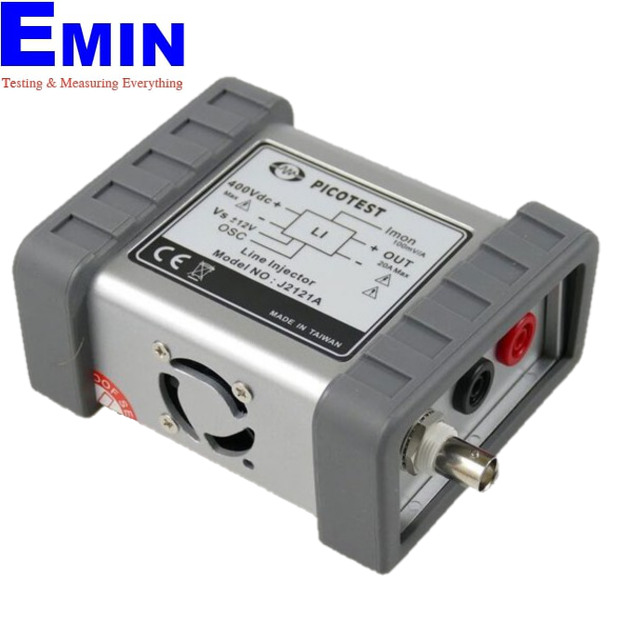
The category also includes a broader range of PICOTEST injector solutions, such as the J2100A, J2101A, and J2102B variants, along with active models like the J2110A, J2111B, J2112A, J2113A, J2120A, and J2121A. In real applications, these products are selected not just by name or bandwidth, but by how they support a specific measurement objective such as loop gain analysis, current modulation, or broadband signal insertion.
How to choose the right injector
The first selection factor is usually frequency range. Some applications only require response from a few hertz to several megahertz, while others demand much wider bandwidth. For example, a model such as the Tekbox TBJT02 focuses on lower-frequency injection up to the MHz range, while options like the PICOTEST J2102B-BNC and J2102B-N are intended for much broader bandwidth use cases.
The second factor is the electrical environment of the test point. Isolation voltage, allowable current, insertion loss, and connector format all affect whether a device will integrate cleanly into the measurement chain. For power electronics or control-loop analysis, engineers often also evaluate the acceptable DC current through the injector and the voltage drop introduced into the circuit.
A third point is whether the setup needs passive coupling or a more active injection method. Transformer-based devices are commonly preferred for straightforward isolation and signal coupling, while active injectors may be more appropriate when current modulation, lower voltage drop, or a specific monitoring function is needed.
Representative products and what they illustrate
The Tekbox TBJT01 and TBJT02 are good examples of compact transformer-based injectors for general-purpose test setups. Their published ranges show that they address different operating windows, helping users choose between lower-frequency emphasis and broader usable bandwidth depending on the DUT and test procedure.
On the PICOTEST side, the J2100A and J2101A illustrate classic injector choices for loop-related work across different frequency spans. The J2120A and J2121A point to use cases involving higher current or higher voltage conditions, where the injector must remain functional without becoming the limiting factor in the test setup. Meanwhile, models such as the J2113A show that some injectors are optimized for very specific measurement scenarios rather than generic coupling alone.
Related components in the signal chain
An injector rarely works in isolation. Real measurement setups often include matching accessories and RF or telecom components to condition, split, isolate, or adapt the signal path. Depending on the lab environment, users may also need adapters for connector compatibility, especially when moving between instrument ports, fixture interfaces, and DUT connections.
In more advanced setups, engineers may combine injectors with a balun, an isolator, or a power divider to improve signal routing, impedance behavior, or measurement stability. Choosing these surrounding components carefully can be just as important as selecting the injector itself.
What matters in B2B purchasing
For engineering teams, the decision is rarely based on one specification alone. Buyers usually need to confirm compatibility with existing instruments, connector standards, voltage and current constraints, and the target measurement method. A suitable injector should support repeatable testing, fit the intended workflow, and reduce the need for improvised coupling arrangements at the bench.
For procurement and technical sourcing teams, it also helps to compare products by application fit instead of just headline bandwidth. Two injectors may appear similar at first glance, yet differ significantly in isolation approach, permissible operating conditions, or intended test topology. Reviewing the product details closely is the best way to shortlist the right option for the lab or production support environment.
Finding the right injector for your setup
This injector category is designed for users who need reliable signal injection across a range of electronic measurement tasks. Whether the priority is low-frequency transformer coupling, broadband injection, or a more specialized active approach, the available PICOTEST and Tekbox models provide options for different engineering test conditions.
If your measurement chain involves specific voltage, current, bandwidth, or connector constraints, it is worth selecting the injector based on the actual test method rather than on catalog labels alone. A well-matched device will make loop analysis, disturbance injection, and bench validation more efficient and easier to reproduce.
-
-
-
-
-
-
-
-
-
-
-
-
-
-
-
-
-
-
-
-
-
-
-
-