


Battery Conductance Tester
Fast battery checks are critical in telecom backup systems, data centers, UPS rooms, energy storage maintenance, and industrial power environments where downtime is costly. When routine inspection needs to move beyond a simple voltage reading, a Battery Conductance Tester helps maintenance teams assess battery condition more effectively and identify weak units before they affect the whole string.
This category focuses on instruments used to evaluate battery health through conductance-based measurement methods. For engineers, service teams, and facility operators, these testers support quicker field decisions, more structured preventive maintenance, and better visibility into the condition of individual batteries over time.
Why conductance testing matters in battery maintenance
In many applications, battery reliability cannot be judged by open-circuit voltage alone. A battery may appear acceptable at rest while still showing signs of aging, reduced performance, or developing internal issues. Conductance testing adds another layer of insight by helping technicians evaluate the battery’s ability to deliver current in practical service conditions.
This makes conductance-based instruments especially useful in scheduled inspections of standby batteries, including common nominal battery types such as 1.2V, 2V, 6V, and 12V units. Compared with more disruptive test approaches, non-destructive battery condition assessment is often a practical option for routine maintenance programs where speed and repeatability are important.
Where battery conductance testers are commonly used
These instruments are typically used anywhere battery continuity and backup readiness matter. Typical environments include UPS systems, telecommunications infrastructure, control cabinets, emergency power systems, and industrial plants that depend on standby DC power. Maintenance teams can use the tester to screen individual batteries, compare readings across a battery bank, and build trend data for replacement planning.
For organizations that need a broader maintenance workflow, conductance testing is often used alongside battery monitoring equipment. Monitoring systems help track ongoing performance, while portable testers support spot checks, commissioning tasks, and troubleshooting during field service.
What to look for when choosing a Battery Conductance Tester
Selection usually depends on the battery types in use, the expected measurement range, portability requirements, and how test data will be handled after inspection. For field work, users often prioritize a clear display, stable readings, onboard memory, and a design that supports efficient movement between battery cabinets or racks.
Another important factor is data recording and transfer. In service environments where traceability matters, built-in storage and export capability can simplify reporting and maintenance history management. Resolution and accuracy are also relevant, particularly when readings are compared over time to identify gradual deterioration rather than only obvious failures.
It is also useful to understand the difference between testing methods. In some maintenance strategies, users may compare this category with a battery impedance tester depending on internal standards, preferred diagnostic approach, and the battery chemistry or installation being maintained.
Example instrument in this category
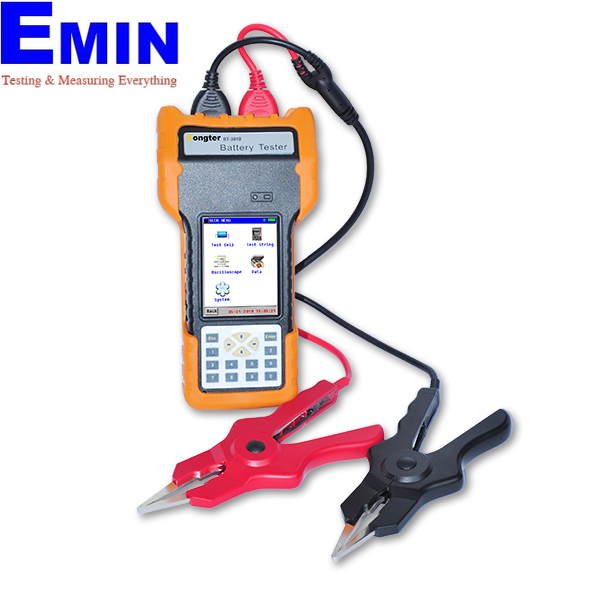
One representative model is the Kongter BT-3918 Battery Conductance Tester. Based on the available product data, it is designed for checking single batteries up to 16V and supports a wide capacity range, making it suitable for several common standby battery formats used in industrial and facility maintenance.
The instrument combines voltage and conductance measurement in a portable format, with touch-screen operation, internal data memory, and USB connectivity for transferring records. For users managing larger maintenance workflows, optional wireless data transmission can also be relevant where test results need to be integrated into an IT-based reporting process.
Kongter solutions for practical field testing
Kongter is one of the featured manufacturers in this category and is relevant for users looking for battery test instruments oriented toward practical service work. In this type of application, portable handling, readable interface design, and the ability to store and move measurement data are often just as important as the measurement function itself.
When evaluating a brand for battery diagnostics, buyers typically consider not only the device range but also how well the equipment fits existing inspection routines. That includes operator training needs, the ease of moving between measurement points, and whether the recorded information can support maintenance documentation and replacement decisions.
How this category fits into a broader battery test workflow
A conductance tester is usually one part of a larger battery maintenance toolkit. It supports fast condition screening at the battery level, while other equipment may be used for simulation, charging analysis, or deeper electrical testing depending on the application. This is particularly relevant in maintenance programs where reliability, compliance, and asset planning are all connected.
For example, test setups may also involve a battery simulating DC power supply in lab, service, or development contexts. While the roles are different, these categories can complement each other within broader battery evaluation and support workflows.
Who should consider this category
This category is especially relevant for maintenance engineers, facility operators, service providers, OEM support teams, and technical buyers responsible for backup power assets. If the goal is to improve preventive maintenance quality without adding excessive test complexity, conductance testing can be a practical step between simple visual checks and more involved diagnostic procedures.
It is also a suitable starting point for organizations building a more consistent inspection routine across multiple sites. Portable testers help standardize field checks, reduce subjective judgment, and create better records for trend analysis, replacement timing, and risk reduction.
Final considerations
Choosing the right battery test instrument depends on the batteries being maintained, the required level of diagnostic detail, and how results will be used after measurement. A well-matched battery conductance testing solution can improve maintenance efficiency, support earlier detection of weak batteries, and make routine inspection data more actionable.
Within this category, buyers can focus on practical criteria such as supported voltage range, portability, display usability, memory capacity, and data export options. For teams working with standby power systems and regular inspection schedules, a Battery Conductance Tester is a useful tool for making battery maintenance more systematic and better informed.
-
-
-
-
-
-
-
-
-
-
-
-
-
-
-
-
-
-
-
-
-
-
-
-