


U-Type Temperature Sensor
Reliable temperature measurement often depends as much on sensor shape and mounting method as on the sensing element itself. In applications where the probe needs to sit firmly against a pipe, heater surface, mold, platen, or metal body, a U-Type Temperature Sensor is a practical option because its form factor supports close contact and stable installation in compact spaces.
This category is suited to users who need repeatable thermal monitoring in industrial equipment, process lines, machinery assemblies, and OEM systems. Rather than focusing only on a single temperature value, the right sensor choice helps improve response consistency, installation safety, maintenance access, and long-term measurement reliability.
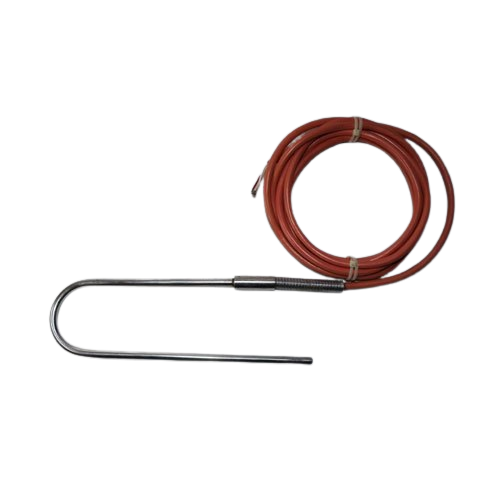
Where U-type temperature sensors are typically used
A U-shaped sensor design is commonly selected when the measurement point is located on a rounded or fixed surface that makes standard straight probes less convenient. This can include heated pipes, cylindrical machine parts, thermal blocks, extrusion systems, packaging equipment, and other industrial assemblies where direct surface contact is important.
In many production environments, installation conditions are just as critical as sensing performance. A U-type format can help simplify mounting in limited spaces, reduce movement at the measurement point, and support more consistent readings when the sensor must remain in position during vibration, thermal cycling, or frequent machine operation.
Why sensor geometry matters in temperature measurement
When selecting a temperature sensor, users often compare sensing technologies first, but mechanical fit has a major influence on actual performance. If the sensor does not sit properly on the target surface or cannot be mounted securely, the reading may react slowly or vary more than expected under changing operating conditions.
The U-type structure is useful because it is designed around the physical shape of the application. This makes it relevant for OEM integration, retrofits, and equipment maintenance projects where the sensor must follow the contours of the installation point. In these cases, choosing the right housing and contact method can be just as important as choosing the sensing principle.
Selection considerations for U-type sensor applications
A practical selection process starts with the operating environment. Users should review the target temperature range, contact surface material, available installation space, cable routing, and exposure to vibration, moisture, or mechanical stress. These factors affect not only measurement accuracy but also service life and ease of replacement.
It is also helpful to consider how the signal will be used in the control system. Some applications need fast trend monitoring, while others prioritize stable long-term measurement for alarms, process control, or equipment protection. If you are comparing form factors across the broader sensor family, related options such as industrial temperature sensors may provide a useful reference for fixed-machine and field installation needs.
Relationship to other temperature sensor types
U-type designs are part of a wider temperature measurement ecosystem, and the best choice depends on mounting style, response expectations, and the electronics used downstream. In compact electronic assemblies, board mount temperature sensors are typically more suitable when the sensing point is located directly on a PCB or inside tightly integrated circuits.
In other systems, users may compare U-type assemblies with common sensor technologies such as a K-Type temperature sensor for broad industrial use or a NTC-type temperature sensor for applications that emphasize resistance-based temperature detection in control and monitoring circuits. The right category depends on both the sensing element and the way the sensor must be installed in the real machine.
Common application goals in industrial and OEM systems
In B2B environments, temperature sensors are rarely chosen in isolation. They are usually part of a larger system that may include controllers, heaters, safety devices, data acquisition hardware, or PLC-based automation. A U-type sensor can support surface temperature monitoring where direct process contact is not practical, or where a compact, secure mounting shape helps maintain a dependable measurement point.
This makes the category relevant for machine builders, maintenance teams, panel builders, system integrators, and procurement teams sourcing replacement or project-based components. Whether the objective is equipment protection, process stability, or thermal feedback for control loops, the sensor’s physical compatibility with the installation point should remain a primary decision factor.
What to review before ordering
Before choosing a specific part, it is worth confirming the required mounting arrangement, cable direction, connection method, and compatibility with the receiving instrument or controller. In many industrial projects, these practical details determine whether installation is straightforward or whether additional adaptation is needed during commissioning.
It is also good practice to check whether the application calls for a sensor optimized for surface contact, immersion, ambient sensing, or PCB integration. If your project is still in the comparison stage, looking across adjacent categories can help narrow down the most appropriate format and sensing technology for the job. This reduces the risk of selecting a probe style that is electrically suitable but mechanically inconvenient.
Choosing a sensor category that fits the application
A well-matched sensor does more than generate a temperature signal. It supports easier installation, more stable operation, and better alignment with the actual conditions of the machine or process. For applications involving curved surfaces or compact mounting points, a U-type configuration can be a sensible starting point when evaluating temperature measurement options.
As you compare products in this category, focus on the relationship between sensor geometry, operating environment, and control requirements. That approach usually leads to a more reliable selection than choosing by sensor type alone, especially in industrial systems where mounting conditions directly affect measurement quality.
-
-
-
-
-
-
-
-
-
-
-
-
-
-
-
-
-
-
-
-
-
-
-
-